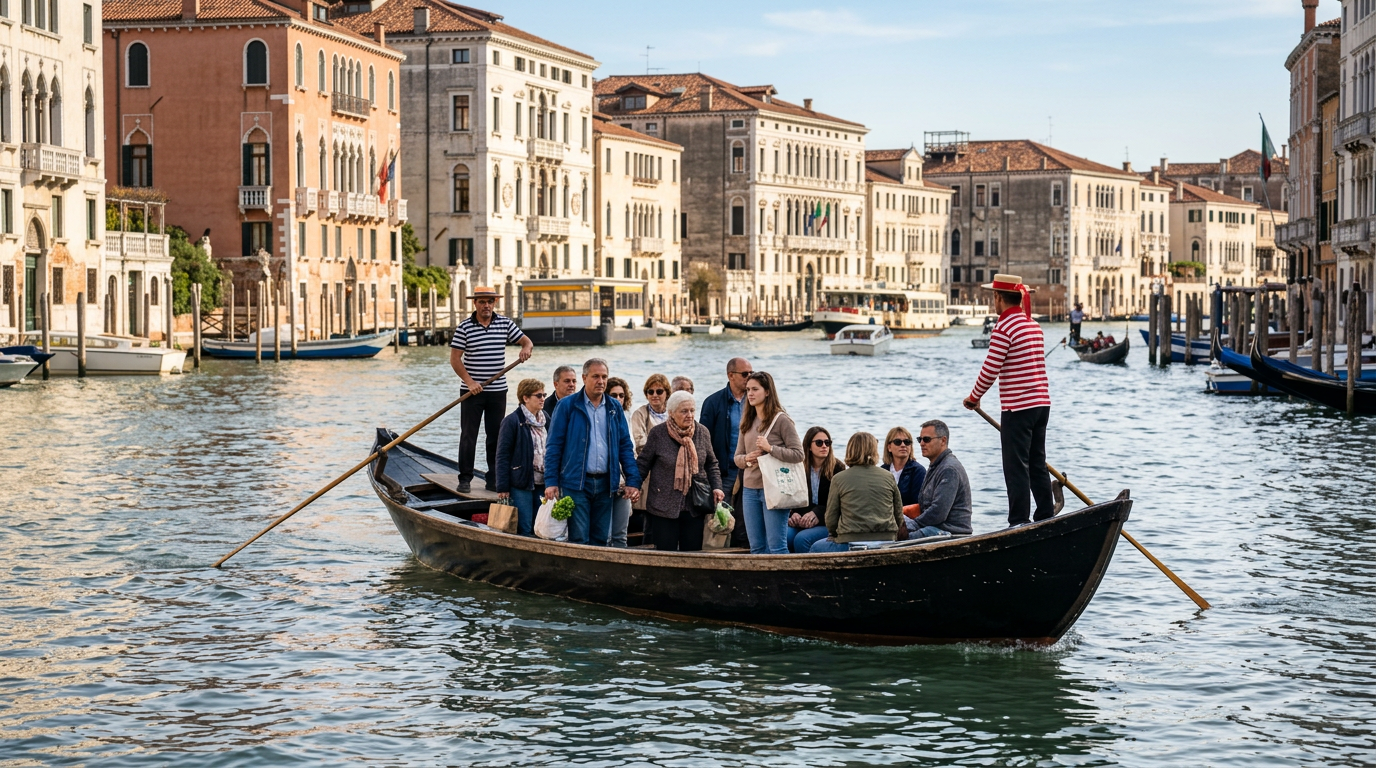
Everyone who comes to Venice dreams of a gondola ride, drifting through quiet canals. But the official tariff for a private, 30-minute ride can make you think twice. We have watched visitors debate the cost, weighing the dream against their budget. But there is another way, a way Venetians have been crossing the Grand Canal for centuries. It does not involve a serenading gondolier or a long, leisurely tour. It involves a two-minute trip, standing shoulder-to-shoulder with Venetians on their way to the market or returning home, for only €2. This is the traghetto, and it is the most authentic gondola experience you can have.
The Traghetto: A Gondola for Getting Things Done
Think of the traghetto (plural: traghetti) as a public ferry, but with all the charm of a real Venetian gondola. These are sturdy, unadorned, workhorse versions of their more famous cousins, operated by two rowers. Their sole purpose is to shuttle people from one side of the Grand Canal to the other at points where there is no bridge nearby. For us, it’s a simple convenience, a way to avoid a long walk to the nearest bridge, like the Rialto or the Accademia.
You will see housewives with their market bags, workers on their lunch break, even children. It is Venice in motion, un-staged and utterly real.
Where to Find Them and How to Ride
There are a handful of traghetto points still in operation along the Grand Canal. A well-known one for visitors is the one connecting the Rialto market to Santa Sofia. After a morning spent among the vibrant stalls, it’s a direct way to the other side. This is a route our own chef takes some mornings after selecting the fresh fish for our daily menu at Osteria Leone Alato.
Other crossings include San Tomà to Sant'Angelo, and near the Punta della Dogana. You simply walk down to the wooden pier (stazio), hand your €2 coin to the gondolier as you board, and find your place. The local custom is to stand, facing forward, but do not feel embarrassed to take a seat; Venetians have better sea legs than most!
The ride is over in a minute or two. It is quick, efficient, and offers a wonderful, low-angle view of the Grand Canal.
A Note on Tourist Traps
The traghetto is pure function, the opposite of a trap. But it brings up a good point: how to spot a real tourist trap in Venice? It is not, as some believe, a menu with photos or in multiple languages. In a city that has welcomed the world for a thousand years, clarity is a form of hospitality. We proudly offer a menu in Italian, English, and Chinese, with photos to help you see the wonderful dishes our chef prepares.
The real warning signs are a menu that is pages long and never, ever changes, regardless of the season. A true Venetian osteria cooks with what is fresh *today*. Another red flag is seafood priced 'al grammo' (by the gram). This can lead to an unpleasant surprise on your bill. We price our fish honestly, per portion, so you know exactly what your meal will cost. That is the Venetian way.
So, while you may still dream of that private serenade, don’t miss the chance to ride the traghetto. For the price of a coffee, you get to participate in the real, living rhythm of Venice. You get to cross the canal like we do. And the euros you save can be spent on an unforgettable meal, perhaps a plate of fresh *seppie in nero* with us on the Fondamenta dei Tolentini, just a short walk from the Piazzale Roma in Santa Croce.