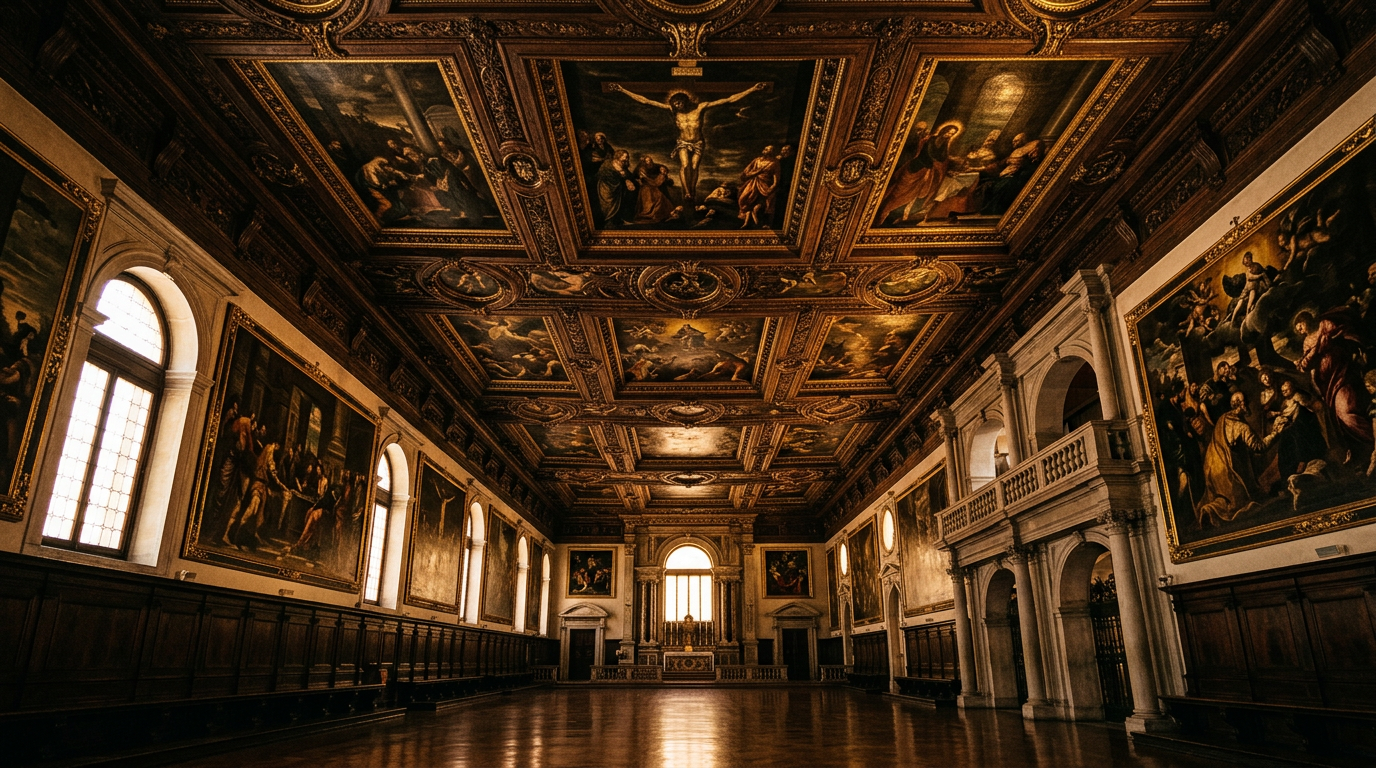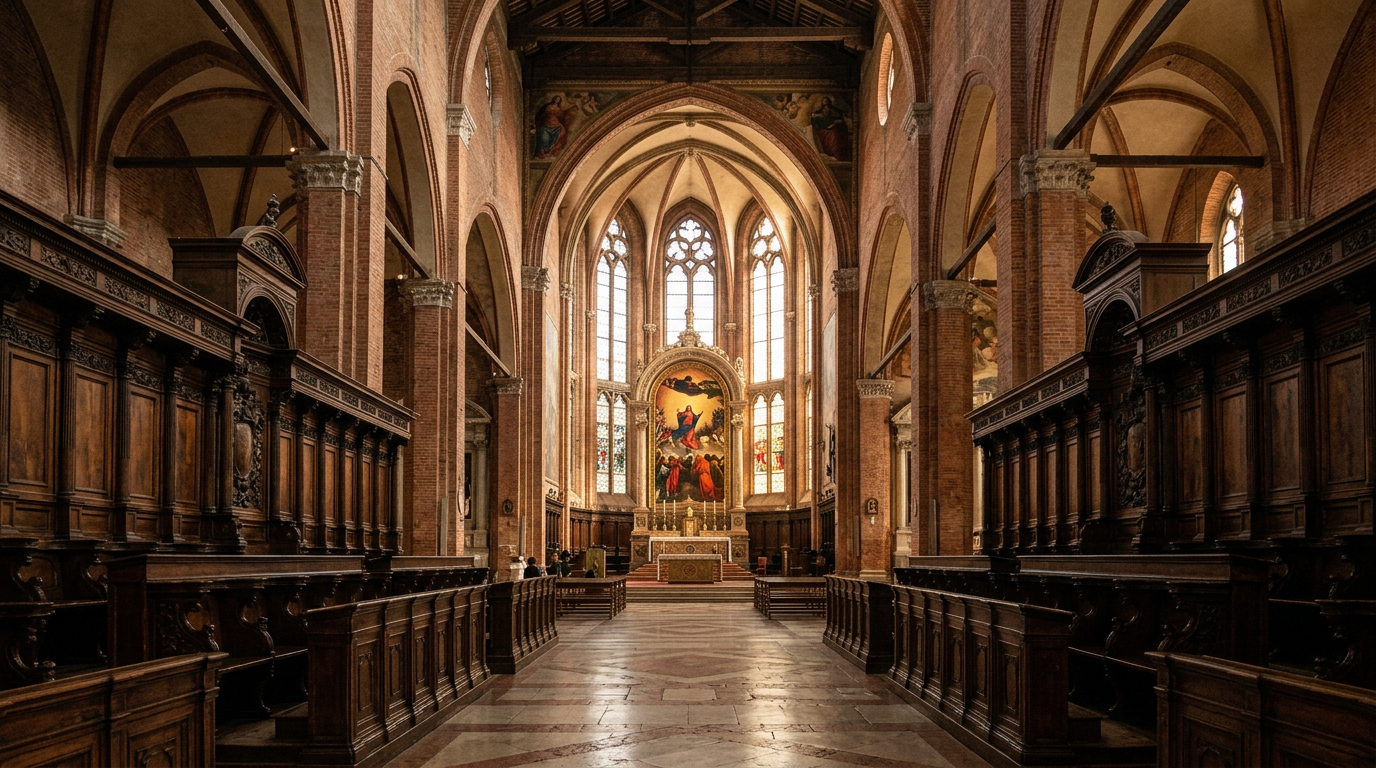
In the heart of San Polo, standing in sharp contrast to the delicate marble of the Palazzo Ducale, rises the red-brick mass of the Basilica di Santa Maria Gloriosa dei Frari. For those of us who live here, the 'Frari' is more than just a church; it is the silent warehouse of the Venetian soul. Walking through its heavy doors, the temperature drops and the scale of the city changes. Here, the Franciscans built on a scale that humbles the viewer, creating a space where the greatest artists of the Republic—Titian, Bellini, and Donatello—left pieces of themselves that have remained unmoved for centuries. It is a place where history feels heavy, architectural, and deeply permanent.
Titian’s Ascension and the Light of the Choir
The focal point of the entire nave is Titian’s 'Assumption of the Virgin' (Assunta), commissioned in 1516. It was a painting so revolutionary in its scale and use of vibrant reds that it supposedly shocked the friars when it was first unveiled. Positioned above the high altar, it draws the eye through the carved wooden choir stalls, creating a sense of vertical movement that mirrors the ascent it depicts.
Across the church, Titian is also present in his finality. His monumental tomb, a 19th-century tribute, stands in the south aisle, but it is the 'Pesaro Altarpiece' that truly commands the space. This work broke all traditional rules of symmetry, placing the Madonna off-center and inviting the viewer to enter the scene from the side, a technique that changed the course of Venetian painting forever.
Quiet Masterpieces in the Sacristy and Transept
While the Assunta captures the grand drama, the sacristy holds a quieter, perhaps more profound treasure: Giovanni Bellini’s 1488 triptych. Enclosed in its original gilded frame, the 'Madonna and Child with Saints' is a study in stillness and light. It is one of those rare places in Venice where you can stand in near-total silence and appreciate the precision of the XV century.成功
Do not overlook the wooden statue of St. John the Baptist by Donatello in the Florentine Chapel. It is the only work by the master in Venice, carved with an anatomical realism that feels startlingly modern amidst the Gothic surroundings. It stands as a testament to the cultural exchange that once flowed freely between the great Italian city-states.
A Walk Toward the Edge of Santa Croce
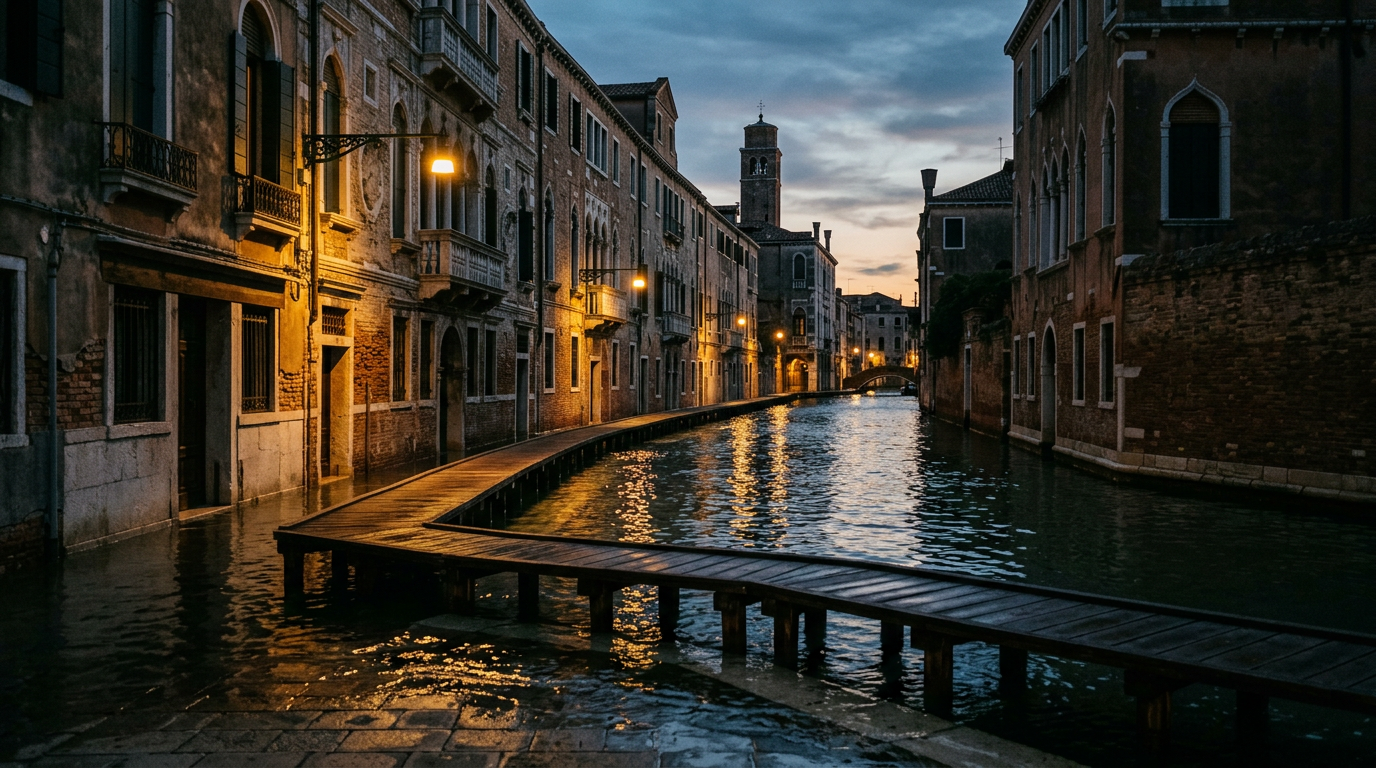
As the sun begins to set, the light through the Frari’s high windows fades, and it is time to move toward the quieter corners of the city. A short walk across the border into the Sestiere of Santa Croce brings a change in atmosphere. This district, often bypassed by those rushing to the station, retains a neighborhood rhythm that is increasingly rare elsewhere.
Passing the Tolentini, the streets widen slightly and the air becomes calmer. We often find that after the visual intensity of the Frari, the soft candlelight of our own Osteria Leone Alato on the Fondamenta dei Tolentini provides the perfect transition back to the quiet of the Venetian night.
The Frari is not a place for a quick visit, but for a slow afternoon of discovery. It reminds us that beneath the surface of the city lies a layer of history that remains as solid as the Istrian stone of its foundations.