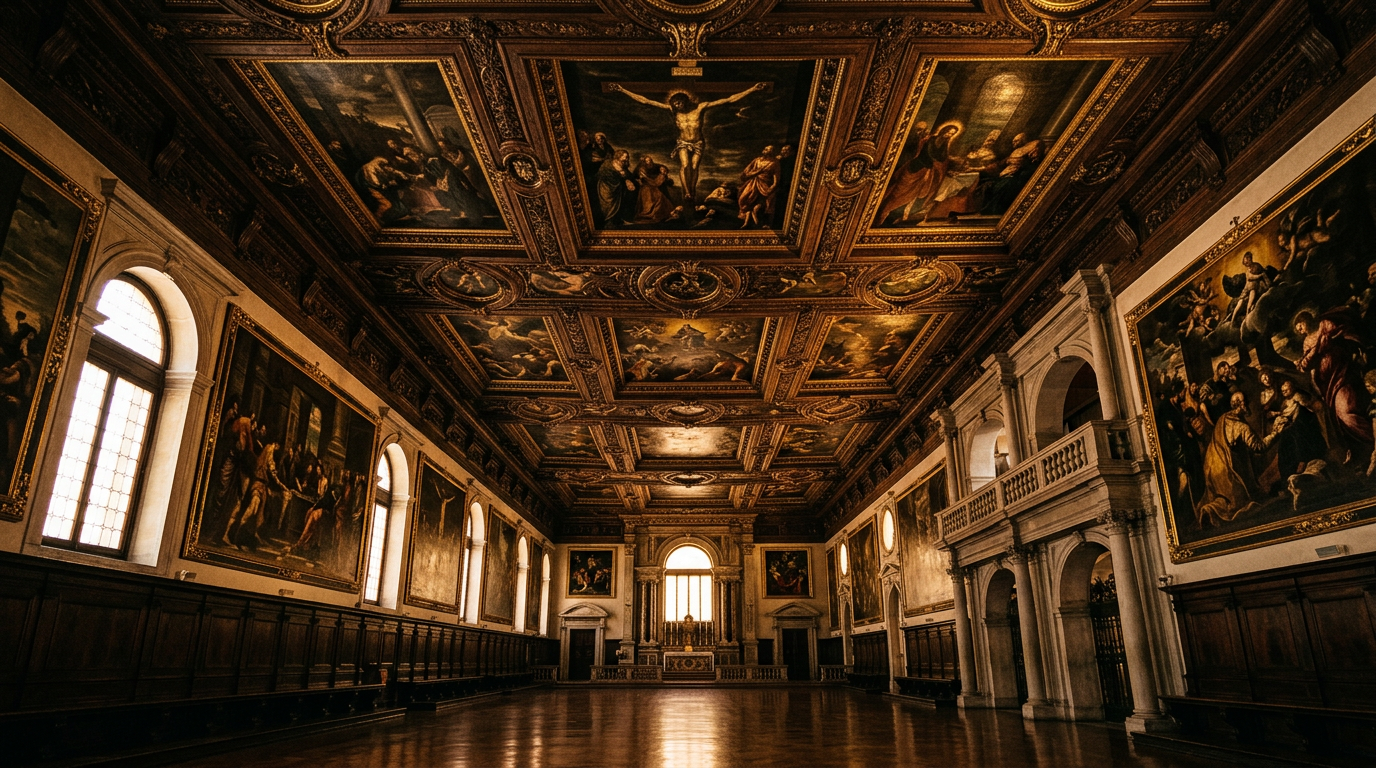
When we speak of the soul of Venice, we often point toward the mosaics of San Marco or the heights of the Campanile. Yet, for those of us who live among these stones, the true heart of the Venetian Renaissance beats within the shadowed halls of the Scuola Grande di San Rocco. It was here, in the San Polo sestiere, that Jacopo Tintoretto spent over two decades of his life, from 1564 to 1587, covering every inch of wall and ceiling with a fury of brushstrokes that redefined what painting could be. To enter these rooms is not merely to visit a museum; it is to step into a singular, obsessive vision. Often called the 'Sistine Chapel of Venice,' it is a place that demands stillness, a sharp eye, and—perhaps most practically—the use of the small mirrors provided to save one's neck from the strain of looking upward.
The Wager of the Sala dell'Albergo
The story of how Tintoretto secured this commission is a piece of Venetian lore. In 1564, the Confraternity of San Rocco announced a competition for the ceiling of the Sala dell'Albergo. While his contemporaries like Veronese and Salviati were busy preparing sketches, Tintoretto secretly painted a finished canvas, 'Saint Roch in Glory', and had it installed in the ceiling overnight. When the judges arrived to see drawings, he simply unveiled the final work, offering it as a gift to the saint. This audacity won him a patronage that lasted twenty-three years.
In this same room, one encounters the 'Crucifixion'. It is a monumental work, over twelve meters wide, that discards the static compositions of the Middle Ages for a cinematic, panoramic view of the event. The light does not come from a single source but seems to radiate from the figures themselves, a hallmark of the 'maniera' that would later influence the Baroque masters across Europe.
Reading the Ceilings of the Sala Superiore
Climbing the grand staircase to the Sala Superiore, the scale of the work becomes almost overwhelming. Here, the Old Testament scenes on the ceiling are paired with New Testament scenes on the walls, creating a complex theological dialogue. It is a dense, intellectual forest of imagery that reflects the wealth and devotion of the Venetian lay confraternities who funded these grand spaces to provide charity for the sick and the poor.
To navigate this without physical strain, the Scuola provides handheld mirrors. By holding them at waist level, you can examine the ceiling panels—like the 'Fall of Manna' or the 'Brazen Serpent'—in intricate detail. You will notice the 'prestezza', the rapid, sketchy brushwork Tintoretto used. Up close, it looks unfinished, but from the floor, it creates a sense of vibrating energy and motion that perfectly captures the divine.
A Short Walk to Santa Croce
The intensity of San Rocco can be exhausting for the senses. As you exit the Scuola, we suggest turning away from the crowded paths leading toward Rialto. Instead, walk five minutes west toward the quieter borders of the Santa Croce sestiere. This is where the city breathes. The fondamenta becomes wider, the tourists thinner, and the architecture shifts from the monumental to the domestic.
As the sun sets over the Tolentini, the neighborhood returns to its residents. After a day spent in the presence of Tintoretto's giants, a quiet dinner at Osteria Leone Alato on the Fondamenta dei Tolentini offers the perfect transition back to the modern world. Here, tucked away from the main tourist artery, one can finally sit in the candlelight and process the visual storm that is San Rocco.
Stepping back out into the Campo, the intensity of Tintoretto’s vision lingers long after the eyes adjust to the Venetian sunlight. It is a weight of history and genius that requires a slow walk to digest.