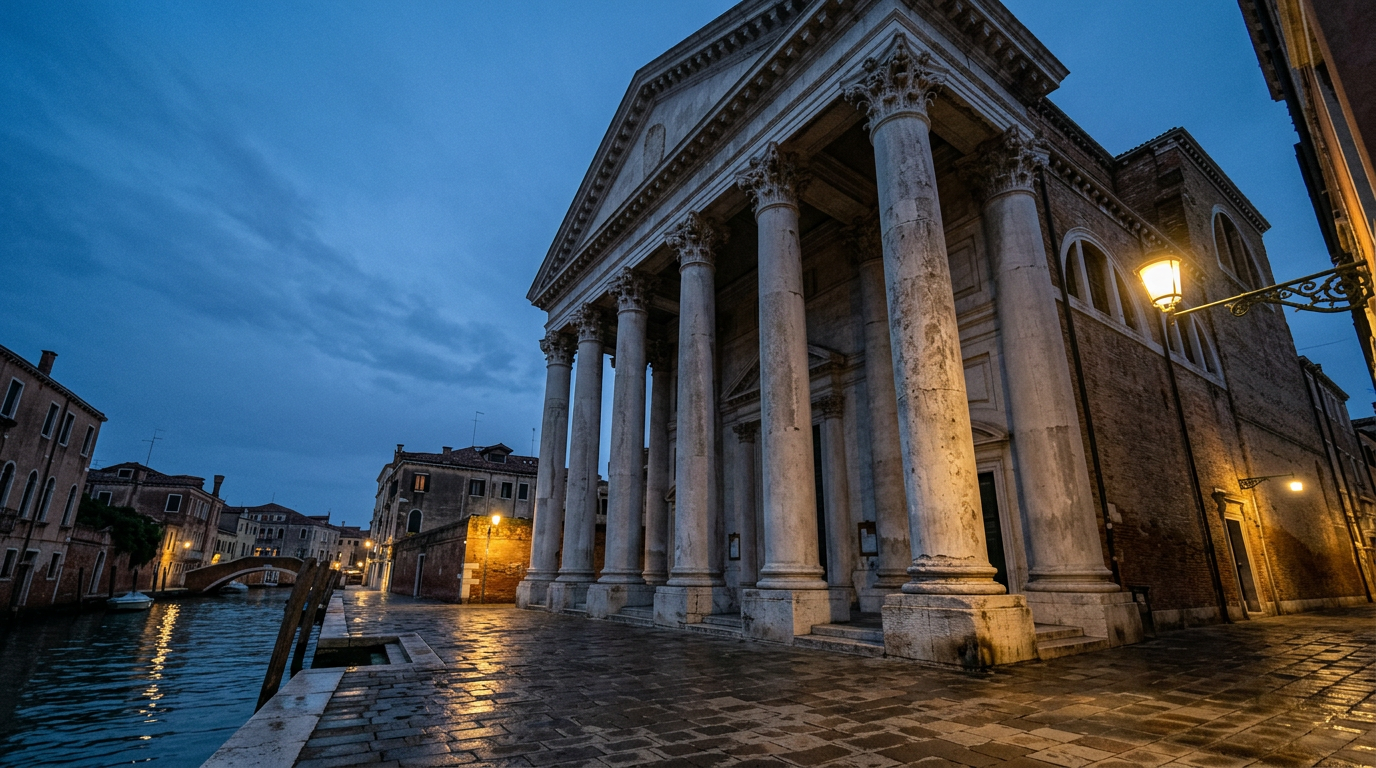
When you arrive in Venice, the city usually presents itself with a flourish of marble and water. Yet, for those of us who live in Santa Croce, the first thing we often see is an unfinished dream. Just steps from the bustling Piazzale Roma and the Santa Lucia station, the church of San Nicolò da Tolentino—known simply to us as the Tolentini—stands with a facade that looks like a Roman ruin frozen in time. Thousands of travellers rush past its Corinthian columns every hour, eyes fixed on their maps, never realizing that this 'incomplete' portico guards one of the most intellectually rich corners of our sestiere. For centuries, this has been the silent guardian of the city’s entrance, a place where the grandeur of the Counter-Reformation meets the modern rigor of Venice's premier architecture school.
The Facade That Time Forgot
The Tolentini is unique in Venice for its massive, freestanding temple front. Designed by Andrea Tirali in the early 18th century, the portico was an attempt to bring the strict classicism of Rome to our lagoon. However, look closely at the pediment and the columns; you will notice the stone remains rough-hewn, lacking the final decorative flourishes that were intended to rival the great temples of antiquity.
This lack of finish isn't a failure; it is a testament to the shifting fortunes of the Theatine order and the Republic itself. It serves as a stark, monumental contrast to the frantic energy of the nearby vaporetto stops. While the exterior speaks of restraint and halted progress, the interior serves as a gateway into a completely different world of Venetian expression.
Baroque Drama and Theatine Splendour
Step inside, and the Roman austerity of the porch vanishes. The interior is a masterpiece by Vincenzo Scamozzi, the man who inherited Palladio’s mantle. It is a space of soaring heights and dramatic light, housing works by Palma il Giovane and the poignant 'St. Jerome' by Johann Liss. The Theatines wanted a space that inspired awe, and even today, the scale of the ceiling frescoes and the intricate marble work achieves exactly that.
One of the most curious details is the presence of a cannonball embedded in the facade, a relic from the 1849 siege of Venice by the Austrians. It is a physical reminder that while Santa Croce often feels like a transit hub today, it has stood at the front lines of the city’s defense and survival for generations.
A Sanctuary of Modern Thought
Directly adjacent to the church is the former monastery, which now serves as the headquarters for IUAV, Venice’s renowned University of Architecture. The entrance, redesigned by the visionary Carlo Scarpa in the mid-20th century, creates a dialogue between the old stone of the Theatine monks and modern geometric precision. This juxtaposition makes the Tolentini a site of pilgrimage for architects worldwide.
Living on the Fondamenta dei Tolentini, we see the students spilling out of the cloisters, sketching the very columns that Scamozzi and Tirali agonized over centuries ago. It is here, in this quiet corner of Santa Croce, that the historical weight of Venice and its creative future physically meet. After a long afternoon spent studying these stones, many find their way to us at Osteria Leone Alato, just a short stroll down the canal, to rest in the shadows of the history they’ve just witnessed.
Next time you step off the train at Santa Lucia, resist the urge to follow the crowds toward the Grand Canal. Instead, cross the Calatrava bridge, walk past the Tolentini, and pause to look up at its scars—they are the quietest stories Venice has to tell.