When we look at our city from the lagoon at sunset, the silhouette of the domes of San Marco doesn't evoke the Gothic spires of the north, but rather the golden shadows of the East. Venice has always been a gate that swings both ways. For centuries, we were more a suburb of Constantinople than a neighbor to Rome. This connection is not merely a matter of trade routes or silk; it is etched into the very stones of the city. To understand Venice, one must look toward the Levant, toward the ghosts of the Byzantine Empire that we both cherished and, in 1204, helped to dismantle. We invite you to look closer at the spoils that define our skyline.
The Spoils of 1204: A City Built on Loot
The year 1204 remains the most controversial chapter in our history. During the Fourth Crusade, under the leadership of the blind Doge Enrico Dandolo, the Venetian fleet turned its sights not on the Holy Land, but on Constantinople. What followed was a systematic stripping of the greatest city in Christendom. Venice did not just return with gold; we returned with the very fabric of an empire.
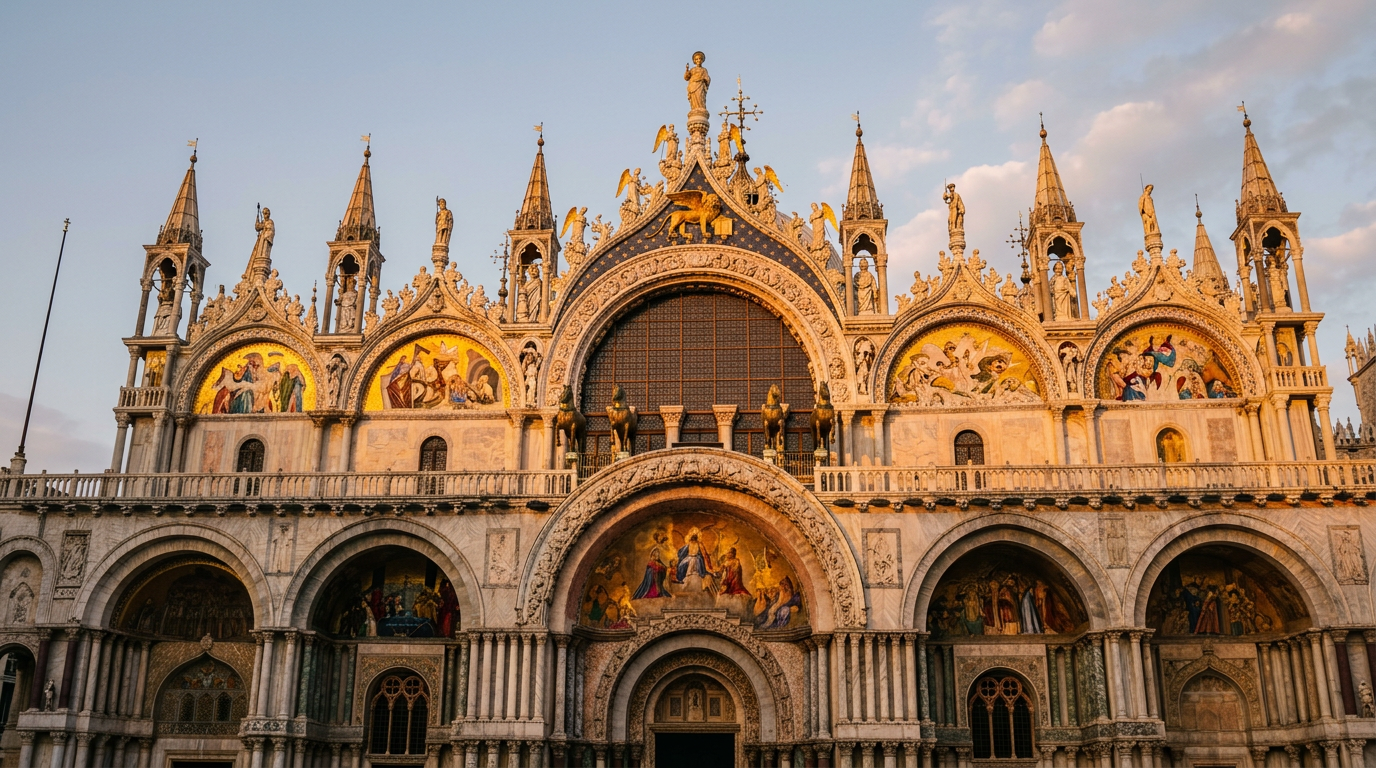
When you stand in the Piazza San Marco, look up at the facade of the Basilica. Those porphyry columns, the intricate marble veneers, and the Four Tetrarchs huddled on the corner near the Porta della Carta were all ripped from the palaces and public squares of Byzantium. We didn't just admire the East; we brought it home piece by piece.
The Bronze Horses and the Hippodrome
Perhaps the most iconic symbols of this 'transfer of glory' are the four gilded bronze horses that stand above the central portal of San Marco (the originals are now safely inside the museum). They once overlooked the Hippodrome of Constantinople, witnessing the chariot races that were the heartbeat of the Byzantine capital.
Doge Dandolo saw them not just as art, but as a statement of supremacy. By placing them on the Basilica, Venice declared itself the true heir to the Roman Empire's eastern half. Even today, their powerful gait seems to suggest they are still marching away from the Bosporus toward the Adriatic.
Reading the Byzantine Architecture
The influence goes deeper than stolen statues. The very blueprint of St. Mark’s Basilica is a direct homage to the Church of the Holy Apostles in Constantinople, a masterpiece that no longer exists. The Greek-cross plan and the five great domes are distinctly Eastern, designed to create a space where light behaves differently—filtering through high windows to illuminate the gold tesserae of the mosaics.
As you walk through the sestieri, especially in the older corners of Castello and Torcello, you see the patera—circular stone reliefs—and the narrow, stilted arches that speak of a Levantine aesthetic. Venice was built by people who looked at the horizon and saw the sun rising over the East, and they reflected that light in their architecture.
To walk through Venice is to walk through a city that never quite decided if it belonged to Europe or the East, a beautiful, stolen mirror of a lost empire.