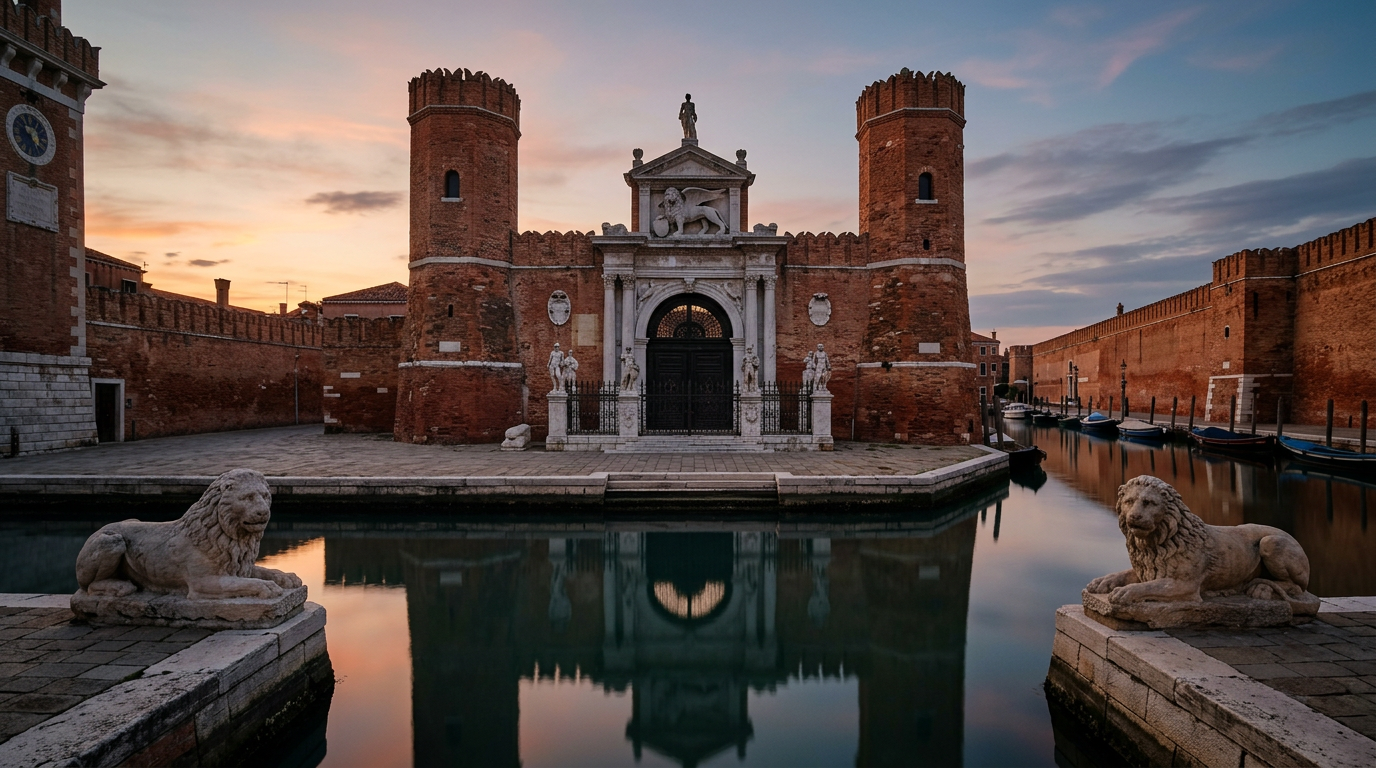
When you walk through the Castello district, you eventually hit a wall—a high, crenellated perimeter of red brick that seems to hold back the weight of history itself. This is the Arsenale. For centuries, this was the heartbeat of our Republic, the largest industrial complex in Europe before the Industrial Revolution even had a name. We often think of Venice as a city of marble palaces and floating churches, but the Arsenale reminds us that we were, first and foremost, a city of shipbuilders. It was here, behind these guarded gates, that the Serenissima forged the galleys that kept the Mediterranean under Venetian thumb. To understand the power of the winged lion, one must look not just at the Doge’s Palace, but at the place where the wood and iron met the water.
The Birth of the Assembly Line
Long before Henry Ford, the Venetian Republic perfected the art of mass production. At its peak in the 16th century, the Arsenale employed sixteen thousand workers, known as 'Arsenalotti'. These men were the city's elite craftsmen, living in the surrounding Castello neighborhood, and their efficiency was legendary. It is recorded that during the visit of King Henry III of France in 1574, the shipyard workers managed to assemble, arm, and launch a complete galley in the time it took the King to finish a banquet.
This feat was possible because of a proto-assembly line system. Standardized parts were kept in warehouses, and as a hull moved along the canal, it passed stations where different teams added masts, rigging, oars, and weaponry. This was a state secret of the highest order; the Venetian Senate forbade master shipwrights from leaving the city under pain of death, ensuring our naval technology remained unparalleled.
Dante’s Boiling Pitch and the Inferno
The intensity of the Arsenale was so famous that it left its mark on world literature. When Dante Alighieri visited Venice in the early 14th century, he was so struck by the sight of the shipyard that he used it as a metaphor for the Eighth Circle of Hell in his 'Inferno'. He described the 'boiling pitch' used to caulk the seams of the ships, a dark, viscous substance that bubbled throughout the winter months.
Even today, standing by the water near the Gaggiandre—the massive shipyard basins designed by Jacopo Sansovino—you can almost feel the heat and the roar of the furnaces. The scale of the architecture, with its wide arches and towering brick walls, reflects a time when this was the most important square mile of territory in the Mediterranean.
What to See Today: From Lions to the Biennale Pentecost
Today, much of the Arsenale is still controlled by the Italian Navy, but its most iconic features are accessible to those who wander to the end of Riva degli Schiavoni. The Porta Magna, built in 1460, is the first neoclassical structure in Venice, flanked by four colossal stone lions brought back as spoils of war from Greece. The largest, the Piraeus Lion, bears 11th-century runic inscriptions carved by Viking mercenaries—a strange collision of Northern and Mediterranean histories.
During the months of the Biennale, the Corderie (the former rope-walks) and the Sale d'Armi open their doors to the public. Walking through the Corderie, a space 317 meters long, you get a physical sense of the sheer volume of rope required to rig a fleet. After a day spent lost in the industrial ghosts of Castello, the walk back toward the western end of the city offers a change of pace. As you reach the quieter canals of Santa Croce near the Fondamenta dei Tolentini, the scale shifts from the monumental to the intimate. It is here, at Osteria Leone Alato, that the city feels most like home, away from the grand shadows of the shipyard.
The Arsenale remains the silent engine of the city’s memory, a place where the scale of Venetian ambition is still etched into the stone and brick. It is a reminder that Venice was not just a city of art, but a city of industry and iron will.