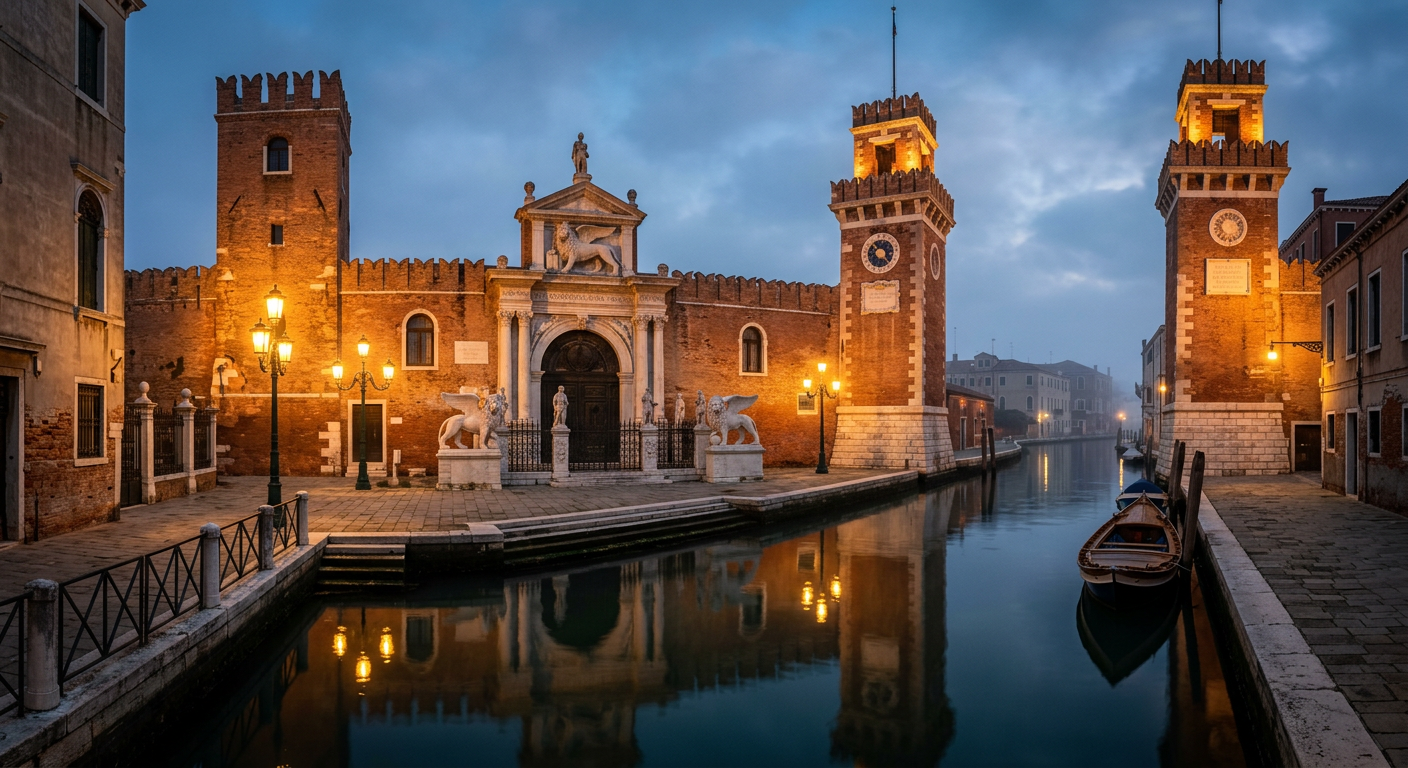
When we walk past the twin towers of the Arsenale in Castello, we are looking at the very engine that built Venice. It was not just a shipyard; it was perhaps the world’s first industrial assembly line, a place of such fierce productivity and scale that it seemed otherworldly to those who saw it. For centuries, this walled complex was the largest industrial site in Europe, employing thousands of 'arsenalotti' who could, at the height of the Republic’s power, assemble a fully armed galley in the span of a single day. This was our secret heart, a prohibited zone of technology and timber that kept the Mediterranean under the shadow of the Winged Lion. Today, though much of it remains under naval jurisdiction, the spirit of that industry still resonates through the heavy brickwork and the lions that guard its land gate.
The Assembly Line of the Serenissima
Long before Henry Ford, the Venetian Republic mastered the concept of standardized parts and vertical integration. The Arsenale was divided into specialized zones: one for the seasoned timber, another for the pitch used for caulking, another for the casting of cannons, and another for the weaving of sails. As a hull floated down the central canal, it would stop at each station, emerging at the end as a finished warship.
At its peak in the 16th century, the Arsenale employed roughly 16,000 workers. These shipwrights were a privileged class of citizens, living in the surrounding streets of Castello. Their efficiency was a state secret; Venice was the only power that could lose a fleet in a storm or battle and have a replacement ready to sail within weeks.
Dante’s Vision of the Pitch-Pits
The atmosphere of the Arsenale was so intense and its scale so vast that it famously inspired Dante Alighieri. In 'The Inferno', Dante uses the image of the boiling pitch in the Venetian Arsenale to describe the fifth chasm of the eighth circle of Hell. He writes of the 'tenacious pitch' used to caulk the ribs of ships, creating a vivid, dark, and industrial imagery that would have been familiar to any medieval traveler who caught a glimpse of our shipyard.
Visiting the Arsenale today, particularly during the colder months when the mist hangs over the water, one can still feel that sense of immense, contained power. The Porta Magna, built in 1460, stands as the first Renaissance structure in Venice, flanked by the lions brought back from Greece as trophies of war. It marks the threshold where the civic beauty of Venice met its military might.
Walking the Perimeter and the Biennale grounds
While the interior of the 'Arsenale Vecchio' is often closed for military use, the 'Arsenale Nord' and the areas used by the Venice Biennale offer a chance to walk among the monumental Tese—the high-vaulted sheds where the ships were once built. The walk from the Riva degli Schiavoni up to the Campo della Tana provides a perspective on how the shipyard defined the entire eastern end of the city.
If you find yourself wandering these brick-heavy foundations of Castello as the sun begins to set, the walk back through the city toward Santa Croce is a long but rewarding one. Our sestiere, Santa Croce, offers a much quieter retreat compared to the grand scale of the Arsenale, and we would be pleased to host you at Osteria Leone Alato for a peaceful conclusion to your explorations.
The Arsenale remains a city within a city, a silent testament to the ingenuity that once allowed a lagoon republic to command the seas. It is the heart of Venice, even if its pulse is now rhythmic with art rather than the hammer of shipwrights.