When people ask us where the true soul of Venetian painting resides, we do not point them toward the crowded galleries of the Accademia or the glittering mosaics of San Marco. Instead, we lead them to a quiet corner of San Polo, where the Scuola Grande di San Rocco stands as a testament to one man’s obsessive genius. Jacopo Tintoretto spent twenty-three years of his life here, transforming the walls and ceilings into a cinematic cycle of spiritual drama. It is often called the Sistine Chapel of Venice, but that title feels almost too bright for what you find inside. In San Rocco, the air is thick with the shadows of the plague and the flickering light of Venetian history. We find that the best way to experience it is slowly, allowing the eyes to adjust to the depth of Tintoretto’s brushes.
The Architect of Shadows: Jacopo Tintoretto
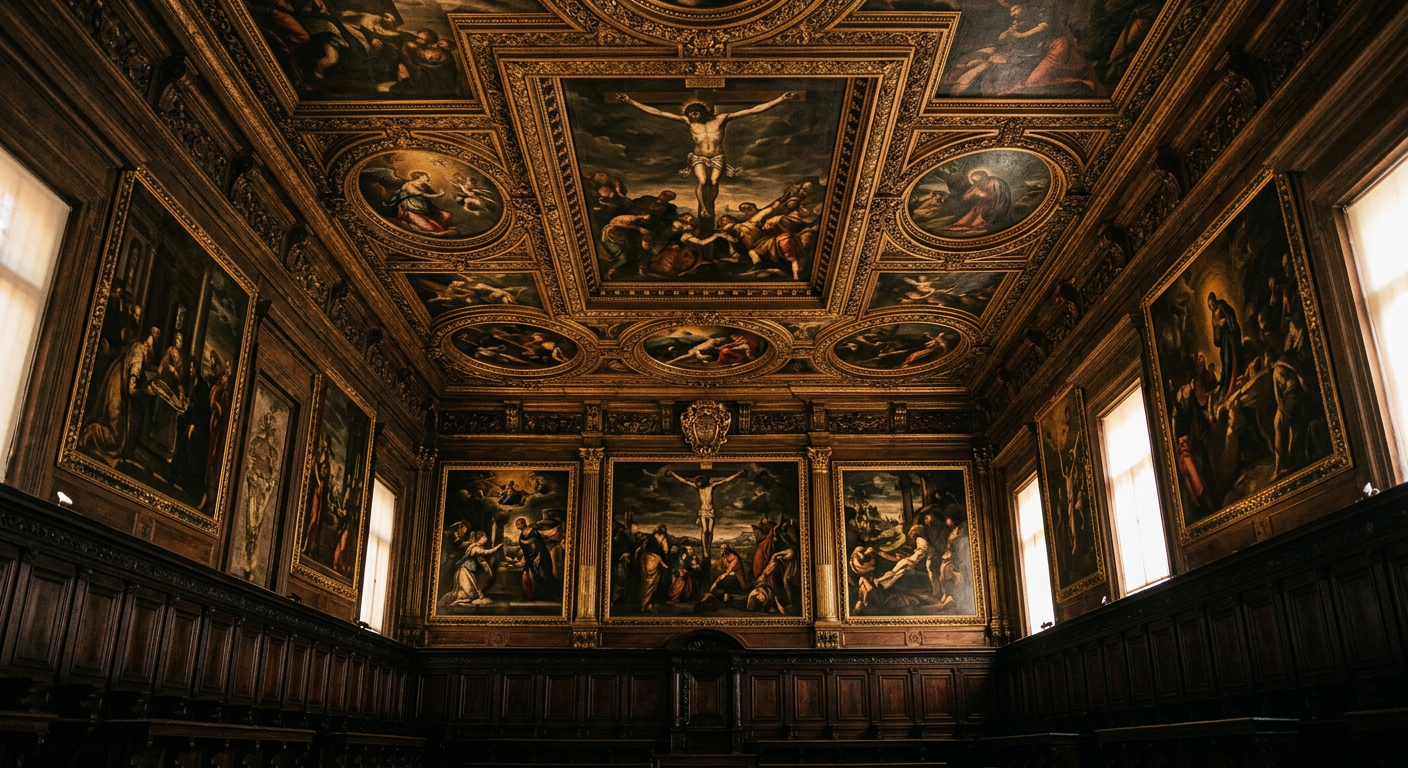
The story of San Rocco is inextricably linked to the 'furioso' nature of Tintoretto. In 1564, when the Confraternity of San Rocco announced a competition to decorate the ceiling of the Sala dell'Albergo, other artists brought sketches. Tintoretto, however, secretly installed a finished painting in the center of the ceiling overnight. This audacity won him the commission and began a twenty-three-year labor that would define his legacy.
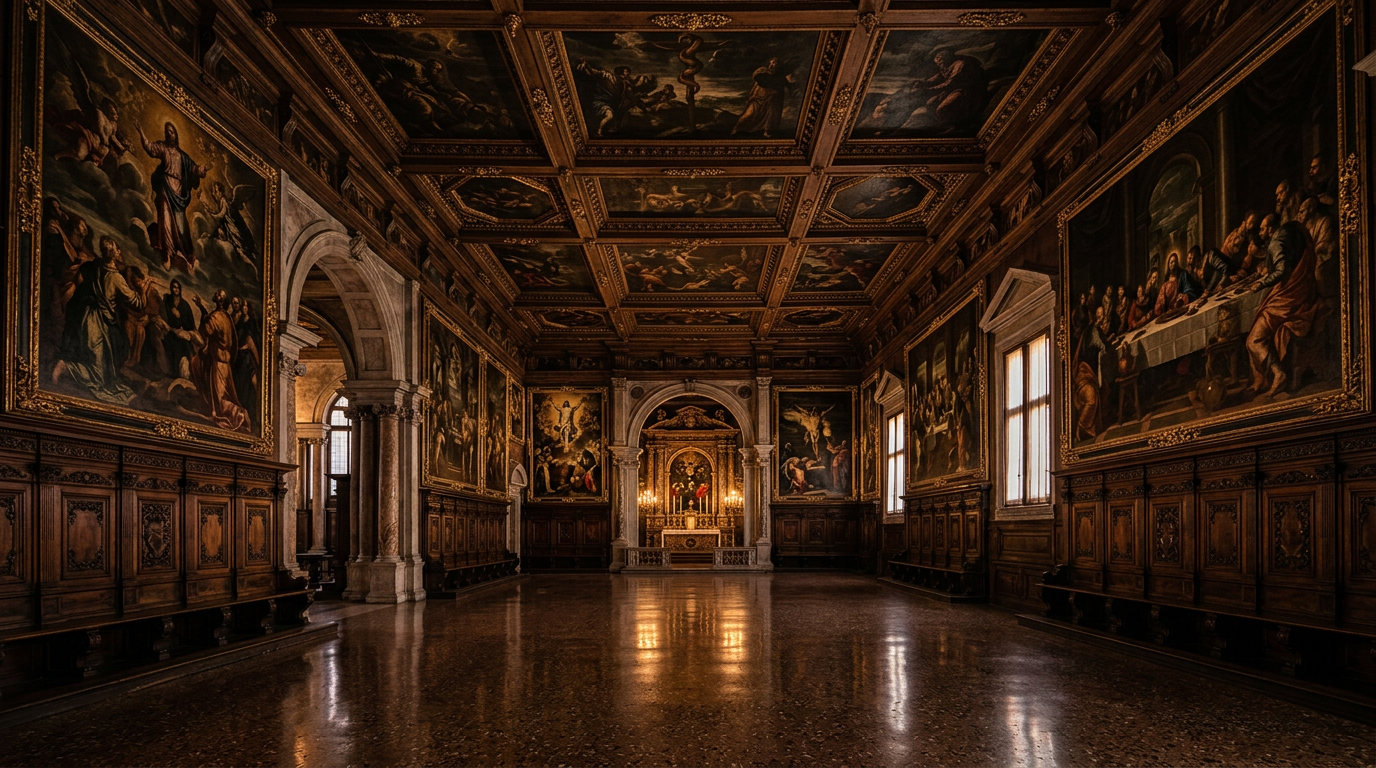
Unlike the balanced harmonies of Titian or the luminous festivities of Veronese, Tintoretto’s work here is restless. He used long, rapid brushstrokes and dramatic chiaroscuro to create scenes that feel as though they are still in motion. To walk through the Upper Hall is to see a painter grappling with the divine through the medium of speed and grit.
Navigating the Sala Superiore and the Mirrors
The sheer scale of the Sala Superiore can be overwhelming. There are dozens of massive canvases overhead, depicting scenes from the Old and New Testaments. To save the necks of visitors, the Scuola provides hand-held mirrors. We suggest taking one and walking slowly through the hall, looking down into the glass to see the heavens reflected.
By using the mirrors, you can appreciate the foreshortening and the way Tintoretto intended for these figures to 'float' above the observers. The cycle creates a complex dialogue between the biblical past and the Venetian present, specifically focusing on the theme of suffering and healing—a poignant choice for a confraternity dedicated to a saint who protected against the plague.
The Crucifixion: A Cinematic Masterpiece
In the Sala dell'Albergo, you will find what many consider to be Tintoretto’s crowning achievement: The Crucifixion. This is not a static, iconographic image, but a vast, panoramic scene that feels like a film still. The canvas spans twelve meters, pulling the viewer into the chaos of the hill at Golgotha.
Notice how the light does not come from a single source, but seems to emanate from the figures themselves, cutting through the gloom. It is a haunting experience to stand before it as the late afternoon light fades outside in the Campo, leaving the painted figures to emerge from the darkness. It remains one of the most powerful encounters with the Renaissance in all of Italy.
Reflecting in Santa Croce
While the Scuola is technically in the Sestiere of San Polo, it sits right on the edge of our own neighborhood, Santa Croce. After the intensity of Tintoretto’s visions, the walk back across the small bridges toward the Fondamenta dei Tolentini offers a necessary transition back to the quiet reality of modern Venice.
Santa Croce is the gateway of the city, yet it remains remarkably still once the sun begins to set. It is the perfect place to sit and process the weight of what you have seen at San Rocco, away from the more frantic energy of the Rialto district. Our osteria serves as a quiet sanctuary in this corner of the city, where the evening moves at a slower pace.
To walk through San Rocco is to see Venice not as a postcard, but as a site of profound intellectual and physical labor. It is a place that demands much of the viewer, but gives back a thousand times more in shadows and light.