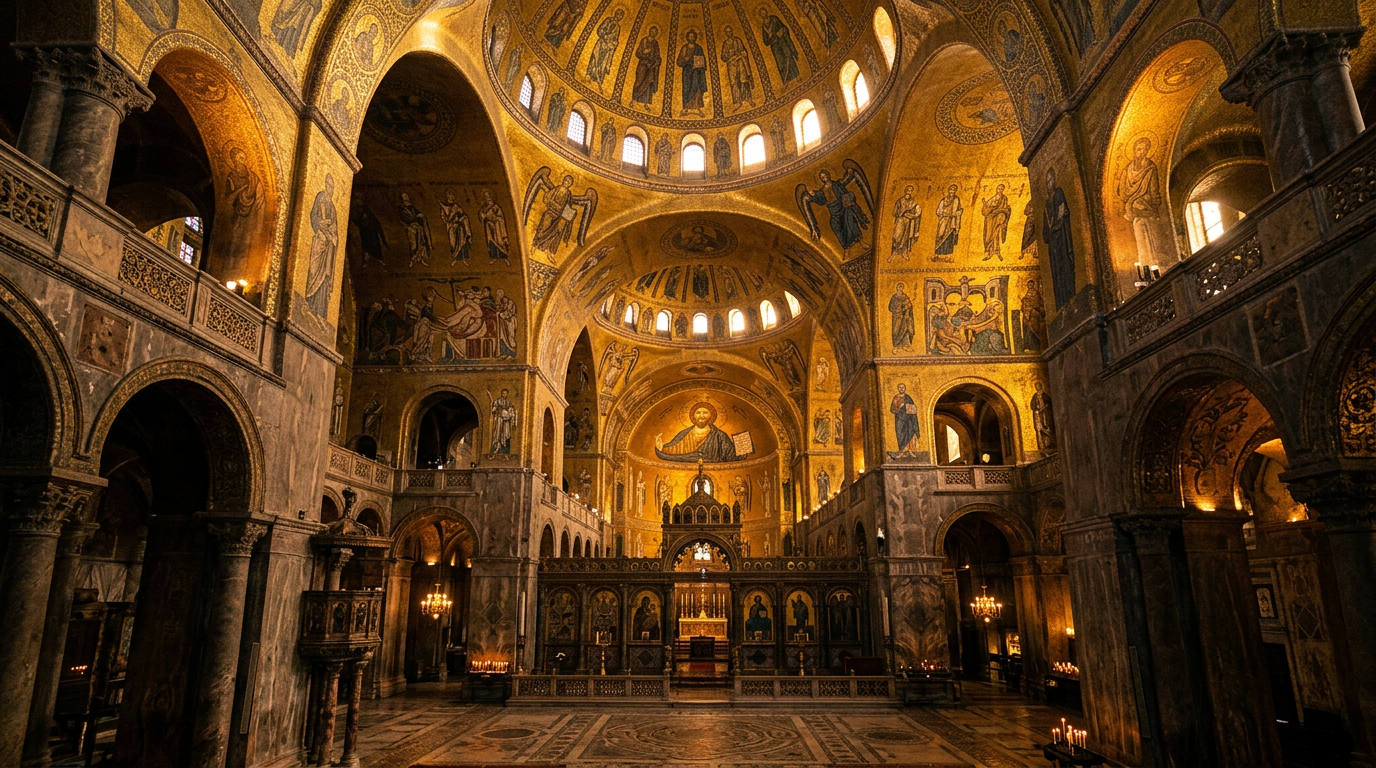
When we look at our city, we see more than just stone and water; we see the shimmering reflection of an empire that fell a thousand miles away. For centuries, Venice turned its back on the Italian mainland, gazing instead toward the sunrise. To understand the Basilica di San Marco is to understand Byzantium. It is not a Romanesque church or a Gothic cathedral in the Western sense—it is a Greek cross, a collection of five domes that mirror the now-lost Church of the Holy Apostles in Constantinople. When the morning light hits the mosaics, you are not in Italy; you are in the Levant. We Venetians have always been a people of the sea, traders who looked East for our gold, our silk, and our very identity.
The Spoils of 1204 and the Fourth Crusade
The year 1204 remains the most controversial date in our long history. Led by the blind Doge Enrico Dandolo, the Fourth Crusade was diverted from the Holy Land to the walls of Constantinople. What followed was the systematic stripping of the 'Queen of Cities'. The spoils of that sack are what give Venice its current face. The porphyry statues of the Tetrarchs, built into the corner of the Basilica, were sliced from a Philadelphion in the East. The pillars of Acre, standing near the Porta della Carta, are witnesses to a city we conquered and dismantled piece by piece.
We did not just trade with Byzantium; we inherited its physical body. When you stand in the Piazza, remember that much of the marble under your feet and the columns framing the sky were once the pride of the Bosphorus. It was a theft of such magnitude that it redefined the aesthetic of the Republic forever.
The Four Bronze Horses of the Hippodrome
Perhaps the most poignant symbol of this Eastern heritage are the four bronze horses that once stood atop the loggia of San Marco. Originally cast in the classical style and placed in the Hippodrome of Constantinople, they were shipped across the Mediterranean as war trophies. For centuries, they looked out over the lagoon, a constant reminder of Venetian naval supremacy and our deep, complicated debt to the Greeks.
Today, the originals are kept safely inside the Basilica's museum to protect them from the salt air, while replicas gallop on the facade. They represent the moment Venice ceased to be a mere vassal of the East and became its successor, claiming the glory of Byzantium as its own birthright.
Reading the City as a Piece of the Levant
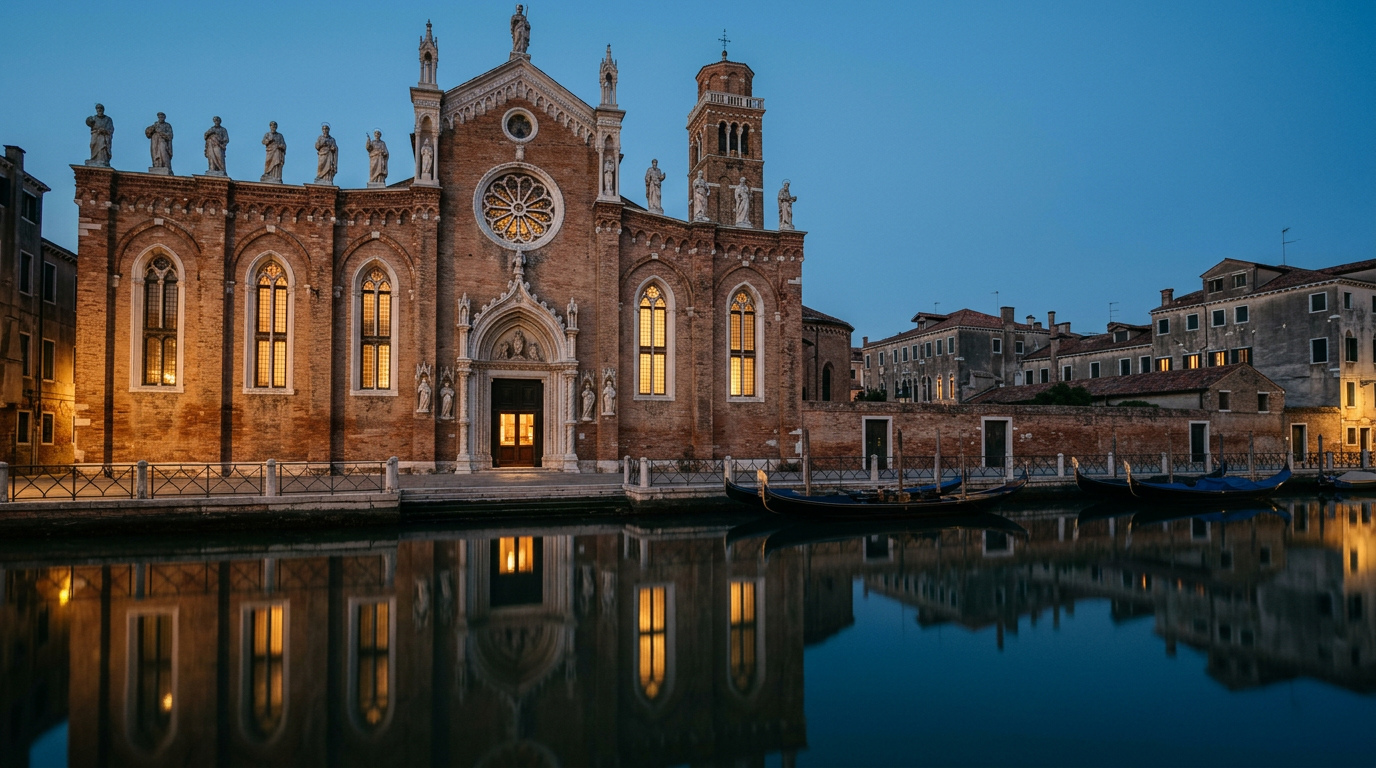
This Eastern influence is not limited to the grand monuments. Walk through the Sestiere of Castello or the quiet corners of Cannaregio, and look at the ogee arches—the pointed, flame-like windows. These are not purely Gothic; they are a Venetian interpretation of Islamic and Byzantine motifs. The city was built by merchants who spent more time in the souks of Aleppo and the markets of Alexandria than in Rome or Paris.
Even the use of gold leaf and deep tesserae in our mosaics reflects a desire for the 'lux munda'—the world light—that defined Eastern Orthodox spirituality. Venice is a hybrid, a city that exists in the tension between the Latin West and the Greek East. To find its soul, one must look toward the horizon.
Returning to the Calm of Santa Croce
As the sun sets and the crowds thin out around the Basilica, the journey back through the city feels like a return to a more intimate reality. While San Marco holds the gold and the grandeur, the sestiere of Santa Croce offers a different kind of history—one of daily life and quiet canals. This is the entry point of the city, yet it remains shielded from the frantic pace of the main tourist arteries.
Once you have traced the lines of the Byzantine empire through the stone of the city, there is a particular peace to be found here. After a day spent among the ghosts of Constantinople, a quiet dinner at Osteria Leone Alato on the Fondamenta dei Tolentini provides the perfect space to reflect on the layers of history that make Venice unique.
Venice is not merely a European city; it is the most beautiful piece of the East that ever drifted across the Adriatic to settle on a mudflat. To walk her calli is to walk the corridors of an empire that refused to die.