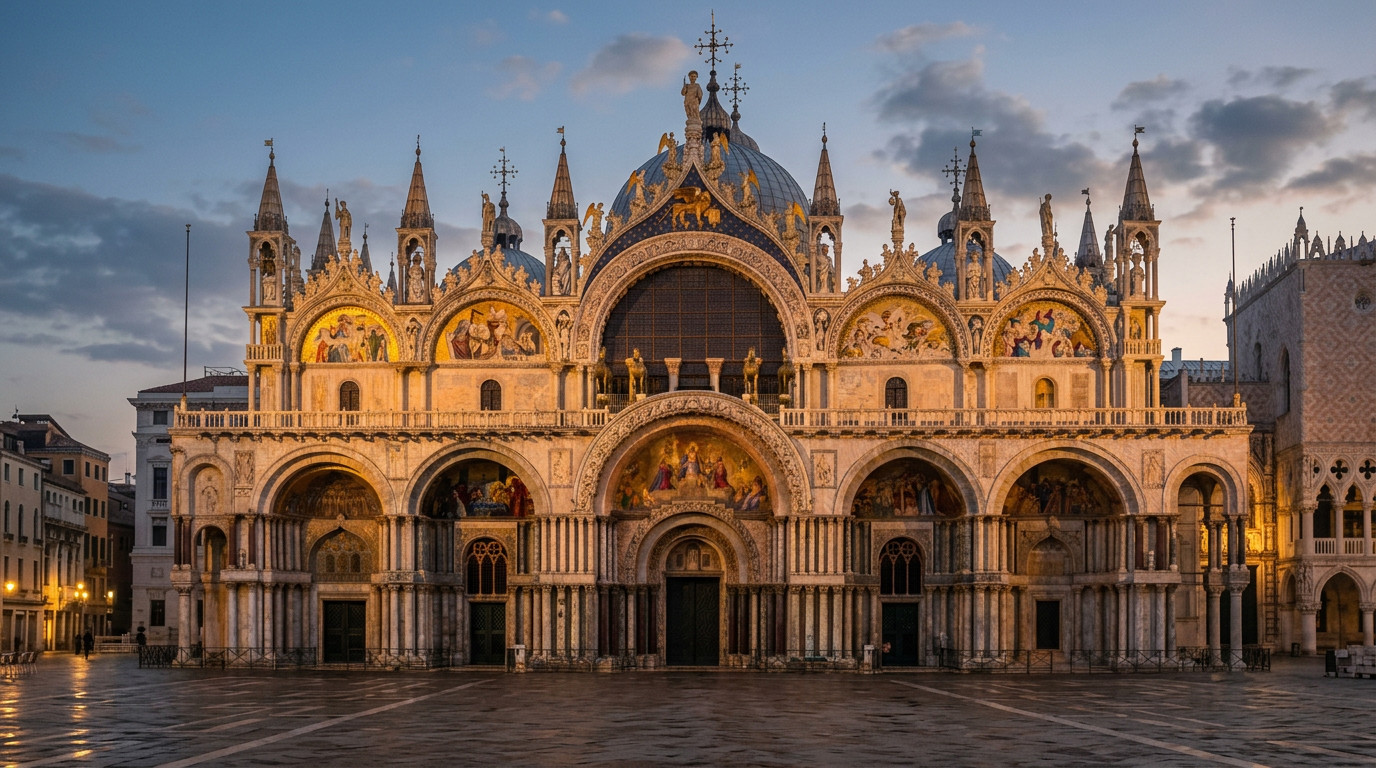
We often say that Venice’s back is turned to Italy. For centuries, our eyes were fixed firmly on the horizon, toward the East—the 'Levante'. When you stand before St. Mark’s Basilica, you are not looking at a purely European creation. You are looking at a fragment of Constantinople transported to the lagoon. This connection is not merely stylistic; it is elemental. The very stones of our city were often carried across the sea in the bellies of galleys, reclaimed from the crumbling greatness of the Byzantine Empire. To understand Venice, one must understand that we were, for a long time, more Byzantine than Roman.
The Spolia of 1204
The year 1204 changed the face of Venice forever. During the Fourth Crusade, under the leadership of the blind Doge Enrico Dandolo, the Venetians diverted the fleet to Constantinople. What followed was the sack of the greatest city in Christendom. We did not just bring back gold; we brought back the city’s bones. The four colossal bronze horses that now look out (in replica) from the loggia of San Mark’s were part of that loot, taken from the Hippodrome of Constantinople.
Look closely at the Piazzetta, near the water’s edge. The two great monolithic columns—one bearing the winged lion, the other St. Theodore—are exotic imports. Even the porphyry sculpture of the Tetrarchs, huddled at the corner of the Basilica, was sliced from a Philadelphion in the East. This practice of 'spolia'—reusing ancient fragments—was how Venice dressed herself in the prestige of an empire she had helped to dismantle.
A Golden Reflection of the East
The architecture of the Basilica di San Marco itself is a direct architectural descendant of the Church of the Holy Apostles in Constantinople. With its five domes and Greek-cross plan, it belongs to the East. Inside, the 8,000 square metres of gold mosaics were executed by masters who brought the secrets of Byzantine craftsmanship to Venice, creating a space where the air itself seems to turn into gold leaf as the sun sets.
Even the floor beneath your feet tells this story. The intricate marble patterns, the 'opus sectile', mimic the floors of the great Byzantine palaces. In Venice, we did not invent these forms; we preserved them. When Constantinople fell to the Ottomans in 1453, Venice became the last living memory of that vanished world.
The Quiet Geometry of Santa Croce
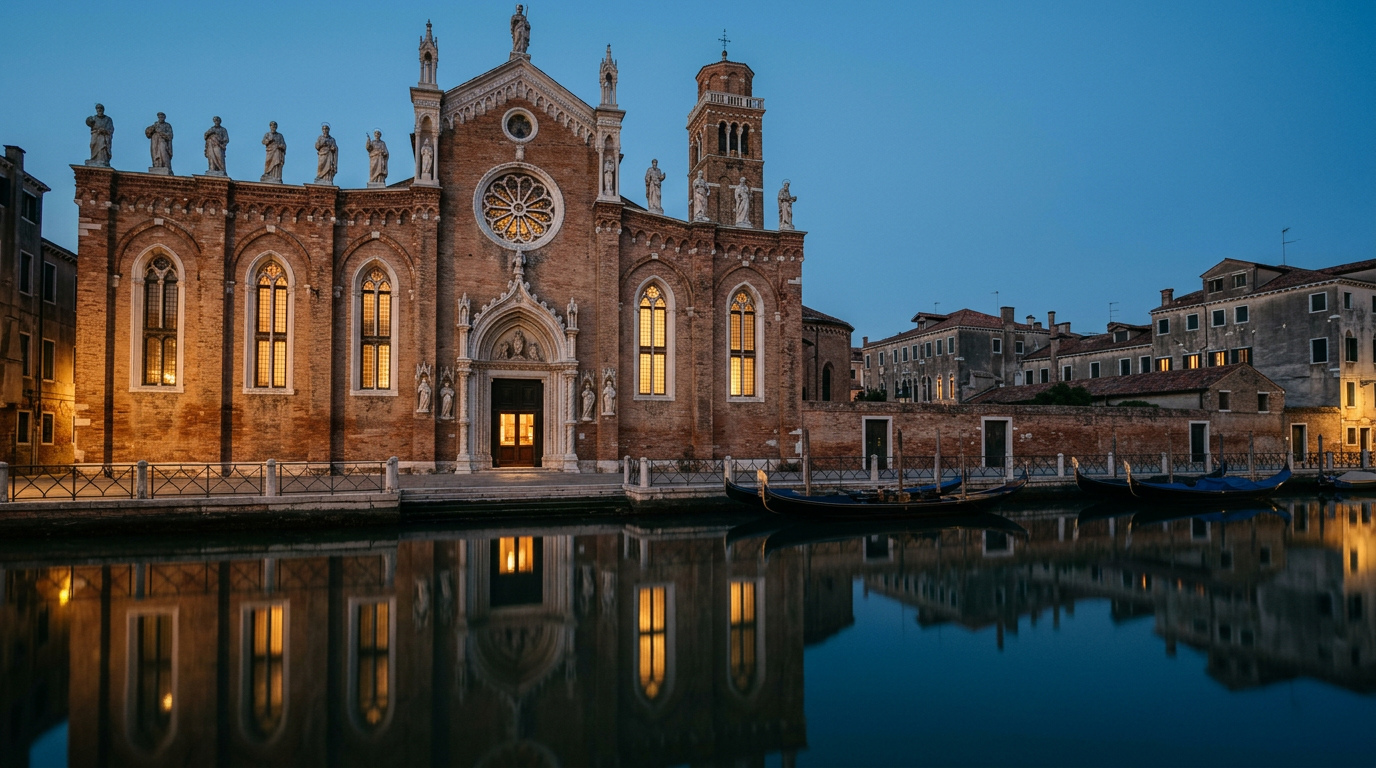
As the day fades and the crowds thin in the Piazza, the walk back toward the entrance of the city—the sestiere of Santa Croce—offers a transition back into the local rhythm. Here, the Byzantine influence is subtler, found in the high, narrow windows and the occasional ancient patera (stone relief) embedded in a crumbling wall.
Santa Croce remains the most authentic threshold of the city. While the rest of Venice can feel like a museum of its eastern conquests, here on the Fondamenta dei Tolentini, the city feels lived-in and quiet. It is an ideal corner to end a journey through history, perhaps with a candle-lit table at Osteria Leone Alato as the canal outside turns to ink.
To walk through Venice is to navigate a city that never quite decided if it belonged to Europe or the Levant. It is in this beautiful, stolen confusion that the city finds its soul.