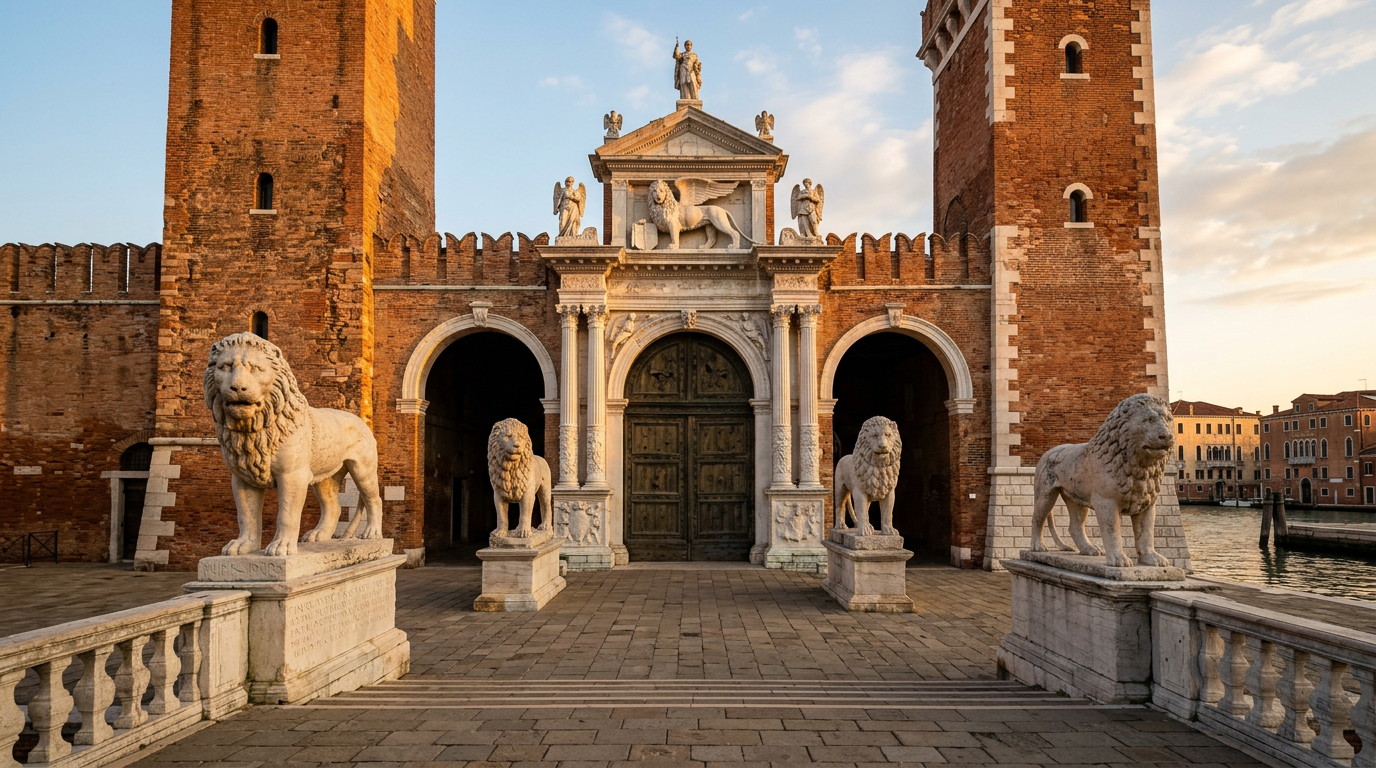
When we walk past the towering red brick walls of the Arsenale, we are not just looking at a shipyard; we are standing at the birthplace of modern industry. For centuries, this was the largest industrial complex in Europe, a city within a city where the Venetian Republic forged its maritime empire. Shielded by high walls and patrolled by the 'Arsenalotti'—the elite workers who lived within a stone's throw of the docks—this was a place of deep state secrets and unparalleled mechanical ingenuity. While the rest of the world was still building ships one by one, we Venetians had mastered the art of the assembly line, a feat of organization that allowed us to dominate the Mediterranean from the Middle Ages through the Renaissance.
The Miracle of the Assembly Line
Long before Henry Ford, the Venetian Republic perfected the standardized production of war galleys. The Arsenale was organized so that a hull would float down a canal, stopping at different stations where specialized workers would add masts, oars, and weaponry. It was a fluid, rhythmic process that allowed Venice to produce a fully armed galley in a single day during times of crisis.
The scale was immense. At its peak, the Arsenale employed up to 16,000 workers. These were not mere laborers but highly skilled craftsmen who held a unique social status in the city. The Republic guarded their loyalty and their secrets fiercely, ensuring that the blueprints of our ships never fell into the hands of rival powers in Genoa or the Ottoman Empire.
Dante’s Inferno and the Boiling Pitch
The atmosphere of the Arsenale was so visceral, so intense, that it famously inspired Dante Alighieri. In the twenty-first Canto of his 'Inferno', he compares the fifth circle of hell to the 'boiling pitch' used in the Arsenale to caulk the seams of the wooden ships. The thick, dark smoke and the relentless noise of hammers were, to him, the perfect earthly representation of a divine torment.
Today, when you stand near the Rio dell'Arsenale, you can still sense that gravity. The walls are not decorative; they were designed to keep the world out. The sheer height of the masonry served as a constant reminder that what happened inside was the lifeblood of the State, far removed from the delicate lace and glass of the tourist quarters.
The Lions and the Porta Magna
The entrance to the shipyard, the Porta Magna, is the first example of Renaissance architecture in Venice, built around 1460. Flanking the gateway are the famous stone lions, ancient spoils of war brought back from Greece. The most famous, the Piraeus Lion, bears runic inscriptions carved by Viking mercenaries—a testament to the far-reaching influence of the Venetian maritime routes.
While much of the interior is now used by the Italian Navy or for the Biennale art exhibitions, the walk around the perimeter offers the best sense of the site's scale. One can walk from the Riva degli Schiavoni towards the eastern edge of Castello, where the crowds thin and the air feels saltier. It is a stark contrast to the arrival point of Santa Croce, where the city begins; here, at the Arsenale, is where the city’s power ended and the sea took over.
Walking back through the city toward Santa Croce, one feels the weight of this history in every paving stone. The Arsenale reminds us that Venice was never just a city of masks and art, but a titan of industry and iron.