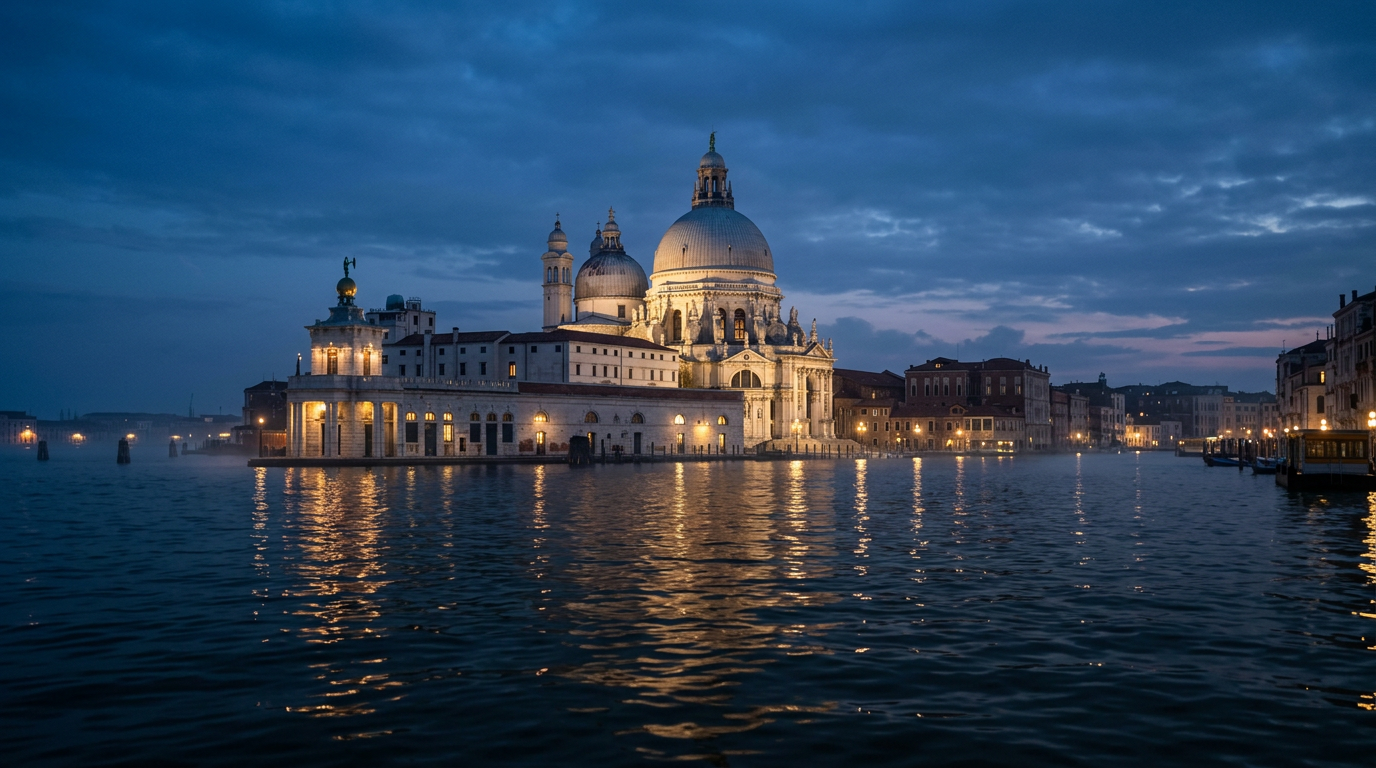
In 1630, the black shadow of the plague descended upon Venice with a cruelty that nearly brought the Republic to its knees. Nearly a third of our population vanished in months. In desperation, Doge Nicolò Contarini and the Senate made a solemn vow to the Virgin Mary: if the pestilence ceased, they would build a church of unprecedented beauty at the entrance of the Grand Canal. That promise became Santa Maria della Salute. When we look at those great white domes today, we don't just see a masterpiece of the Baroque; we see a votive offering, a literal 'thank you' in stone, standing where the sea meets the city. It is a landmark of survival that has defined the Venetian skyline for nearly four centuries.
Longhena’s Octagonal Vision
The task of building this monument was won by a young architect named Baldassarre Longhena. He departed from the traditional Latin cross plan, choosing instead an octagonal shape that feels like a crown rising from the water. This was not merely an aesthetic choice; the octagon symbolizes the Resurrection and the eighth day, a fitting tribute for a city reborn from the ashes of disease.
Supporting this massive structure are over a million timber piles driven into the mud of the lagoon. It is a feat of engineering as much as art. Inside, the space is flooded with light, drawing the eye toward the high altar where a sculptural group depicts the Virgin driving away the Plague—portrayed as a wretched old woman—protecting Venice at her feet.
The Bridge of Gratitude: November 21st
While the Salute is a fixture of the Grand Canal, it truly comes alive on the 21st of November. This is the Festa della Salute, one of the most local and heartfelt days in our calendar. To facilitate the pilgrimage, the city constructs a temporary 'ponte votivo'—a floating pontoon bridge that stretches across the Grand Canal from Santa Maria del Giglio directly to the church steps.
Walking across this bridge is a rite of passage for every Venetian. We do not do it for the view, but to light a long white candle for the health of our families. The air around the Salute becomes thick with the scent of beeswax and the low murmur of prayers, a tradition that has remained unbroken since the 17th century. It is a day when the city feels small, intimate, and profoundly connected to its past.
A Sanctuary in the Sestiere of Santa Croce
The crowds during the festival are concentrated around the Dorsoduro and San Marco districts, where the bridge connects. For those who seek to process the weight of this history in a calmer setting, the walk back toward the west of the city leads to our own sestiere, Santa Croce. It is the quietest corner of the city, away from the ceremonial hubbub.
After the candles have been lit and the prayers whispered, we invite you to cross back into the stillness of the Tolentini area. At Osteria Leone Alato, the atmosphere remains candle-lit and serene, offering a gentle end to a day of historical reflection in the heart of Venice.
To see the Salute is to understand the Venetian soul—resilient, devout, and deeply tied to the water that both brings life and demands sacrifice.