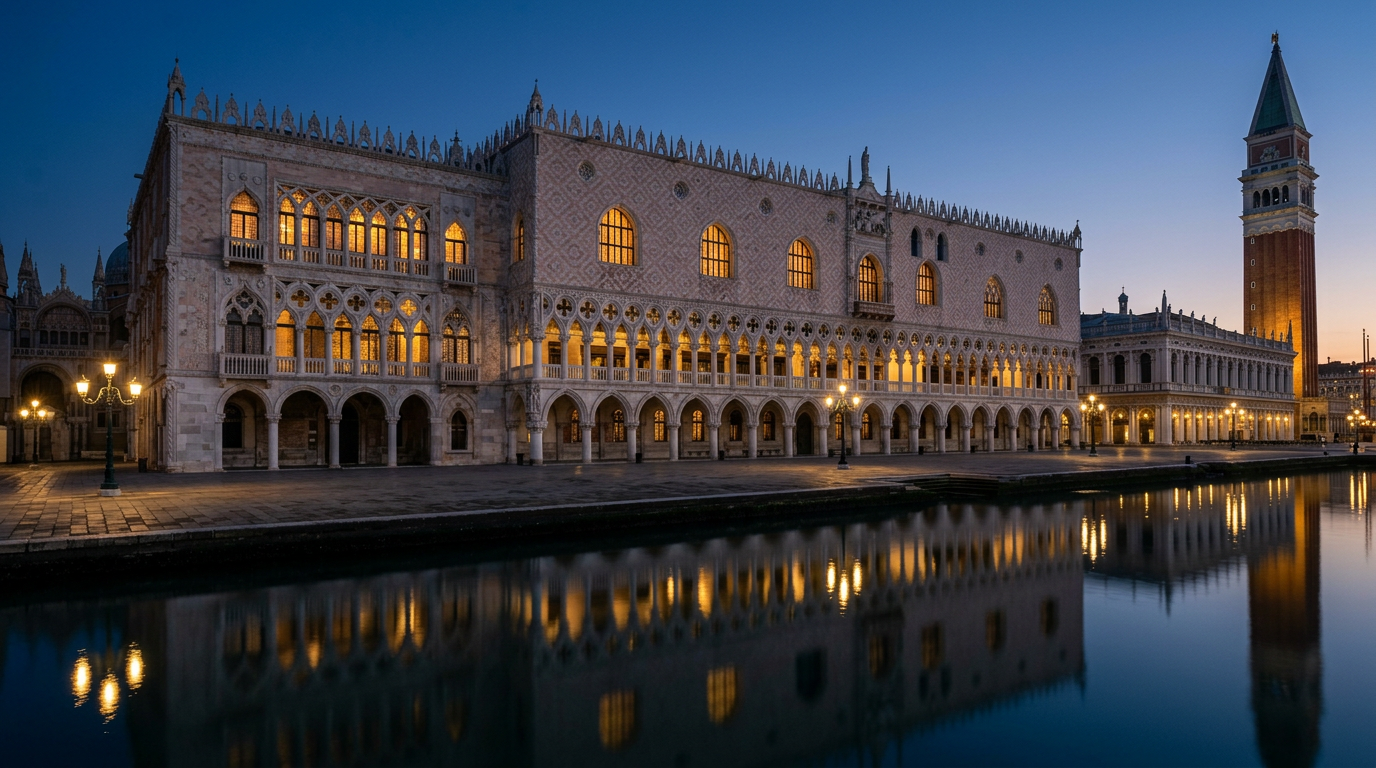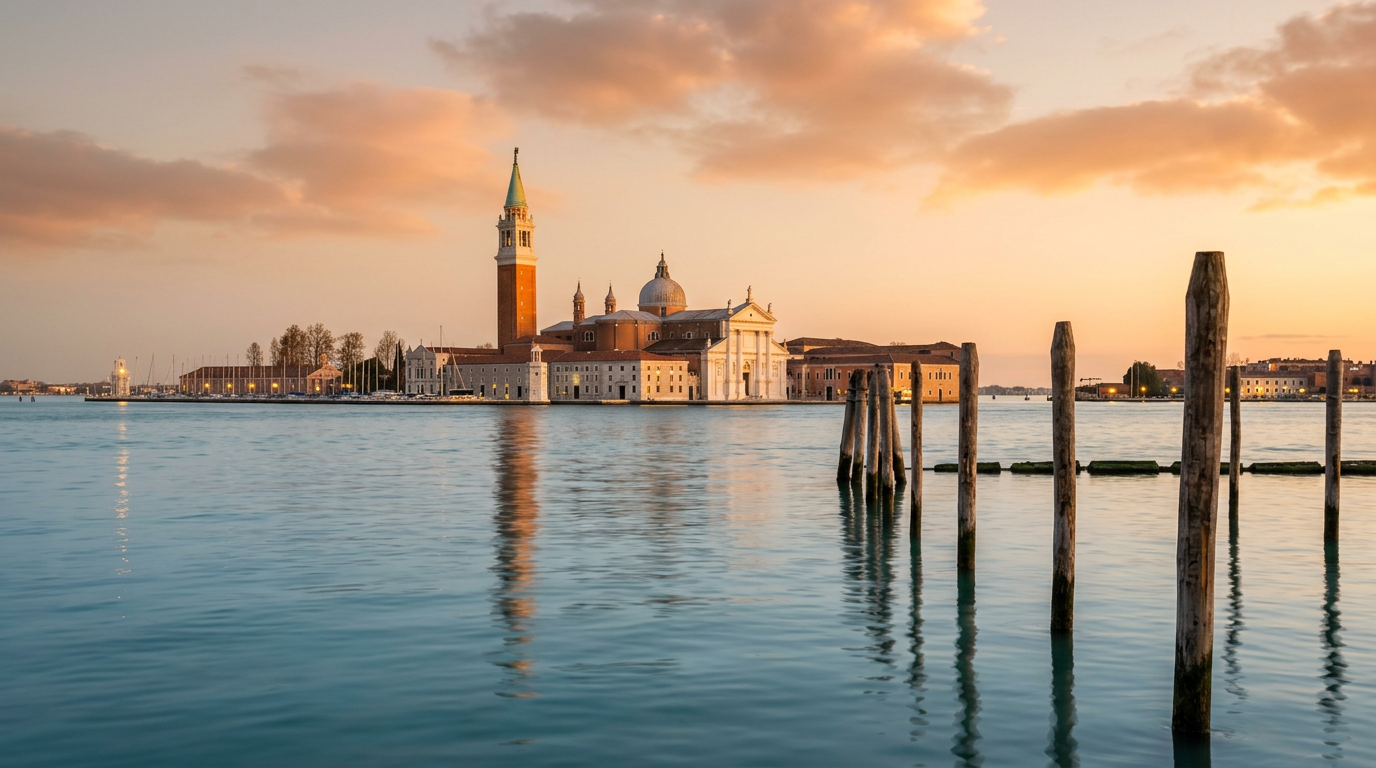
When we look out across the Bacino di San Marco, our eyes are invariably drawn to the brilliant white Istrian stone of San Giorgio Maggiore. Standing isolated on its own island, it serves as a serene counterpoint to the decorative frenzy of the Palazzo Ducale. Designed by Andrea Palladio in 1566, the church is a masterpiece of High Renaissance clarity—a vision of Roman temples translated into the Venetian lagoon. For those of us who live here, it is more than just a landmark; it is a sanctuary of space and light, offering a perspective on the city that one simply cannot find within the narrow calli of the main islands. It is a short vaporetto ride away, yet it feels like a different world entirely.
Palladio’s Geometric Vision
The façade of San Giorgio Maggiore is a lesson in architectural harmony. Palladio solved the ancient problem of how to fit a classical temple front onto a Christian church by nesting two distinct pediments—one tall and narrow for the nave, and one lower and wider for the side aisles. The result is a structure that feels both grounded and soaring.
Inside, the space is flooded with light, reflecting off the pale stone and white plaster. Unlike the dark, mosaic-heavy interiors of San Marco, San Giorgio feels airy and intellectual. It was designed for the Benedictine monks, whose monastery still occupies a significant portion of the island, housing the prestigious Cini Foundation today.
Tintoretto’s Final Masterpieces
While the architecture is Palladian, the soul of the chancel belongs to Jacopo Tintoretto. Here, you will find two of his most significant late works: 'The Fall of Manna' and, most famously, his final version of 'The Last Supper'. Painted between 1592 and 1594, this is not the static, frontal composition of Da Vinci.
Tintoretto’s scene is diagonal, dramatic, and swirled with supernatural light. Ghostly angels hover near the ceiling, formed from the smoke of oil lamps. It is a powerful example of the Venetian Mannerist style, where the divine and the everyday collide in a dark, atmospheric space that contrasts sharply with the brightness of Palladio’s nave.
The Finest Panorama in Venice
If you are looking for a view of Venice, we always suggest skipping the queues at the San Marco campanile and taking the lift here instead. From the bell tower of San Giorgio, the entire layout of the city reveals itself. You can trace the curve of the Riva degli Schiavoni and see the Giudecca canal stretching toward the west.
The ascent is via a modern lift, and the top offers a 360-degree perspective that includes the lagoon islands and, on clear days, the distant peaks of the Dolomites. It is the only place where you can truly appreciate the relationship between the city’s dense urban fabric and the vast, shifting waters that sustain it.
Navigating the Island
Reaching San Giorgio Maggiore is straightforward but requires a specific route. Take the Linea 2 vaporetto from San Zaccaria or Giudecca; the church has its own dedicated stop. The island is quiet once the last boat departs, so we recommend visiting in the late afternoon when the sun hits the façade directly.
After you return to the main city, the transition from the open lagoon back to the intimate scale of the sestieri is best experienced in Santa Croce. Away from the transit hubs of Piazzale Roma, our neighborhood settles into a gentle rhythm. You might conclude your day with a candle-lit dinner at Osteria Leone Alato, tucked away on the Fondamenta dei Tolentini.
Whether you come for the Tintorettos or the skyline, San Giorgio Maggiore remains a place of profound silence, even when the crowds at San Marco are visible just across the water. It is a reminder of how Venice, for all its theatricality, was built on a foundation of rigorous, classical grace.