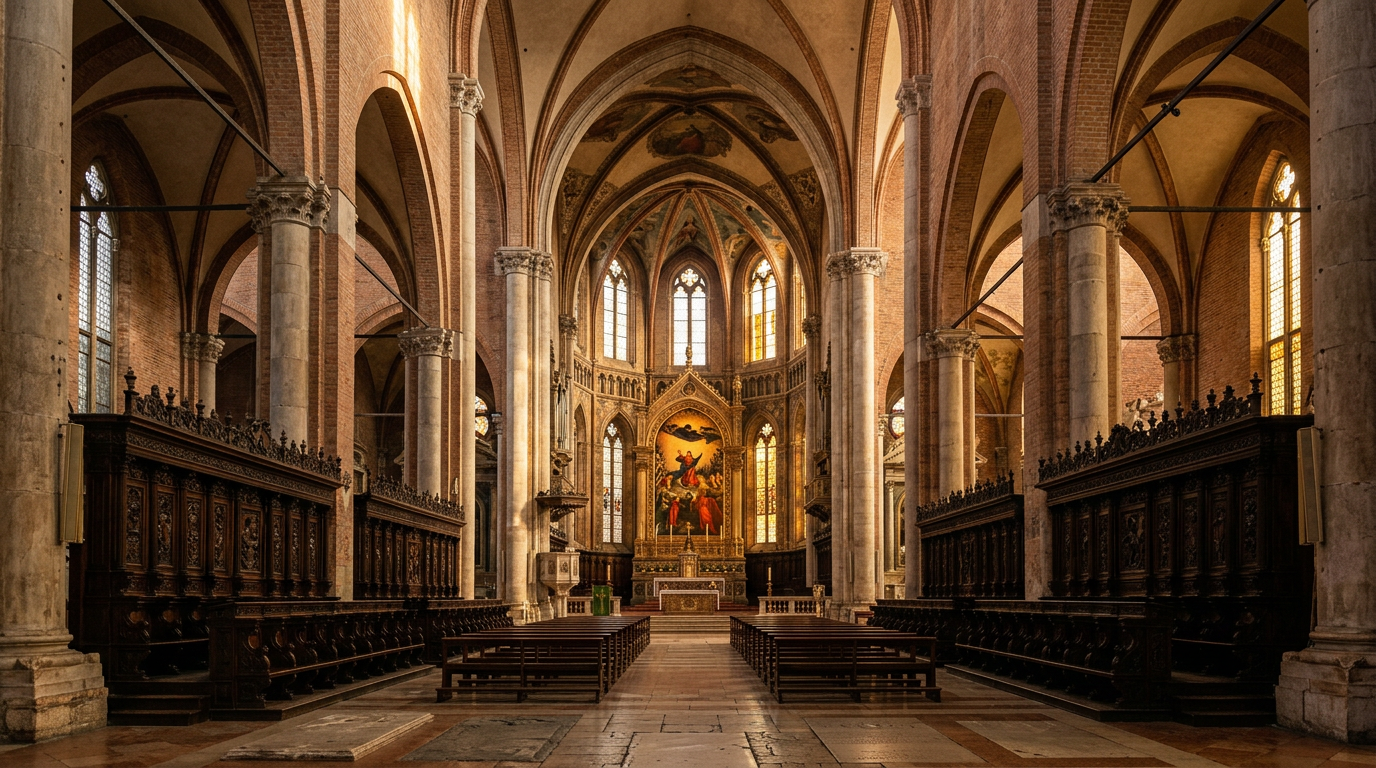
When we walk through the sestiere of San Polo, the massive brick silhouette of the Basilica di Santa Maria Gloriosa dei Frari serves as our North Star. It is not the white marble of the Salute or the gold of San Marco that defines the Venetian spirit for us, but this austere Franciscan monument. For over seven centuries, it has stood as a silent witness to the city's artistic evolution. To enter the Frari is not merely to visit a church; it is to step into a monumental reliquary of the Venetian Renaissance. Here, the sheer scale of the architecture competes with the emotional weight of the masterpieces housed within, creating a space where history feels remarkably present.
Titian’s Assunta: A Revolution in Red
At the heart of the basilica, suspended above the high altar, hangs Titian’s 'Assumption of the Virgin' (1516-1518). When it was first unveiled, its scale and kinetic energy shocked the Venetian public. The vibrant 'Titian red' of the Virgin’s robes draws the eye upward, mirroring the physical ascent of the soul. It remains one of the most powerful compositions in Western art, framed perfectly by the Gothic arches of the choir.
Directly across the nave lies the artist's own resting place. Titian died during the plague of 1576, and his massive 19th-century funerary monument serves as a counterpoint to the vibrant life of his paintings. It is a rare moment in art history where a master is buried within sight of his greatest achievement.
The Sacristy and Bellini’s Quiet Perfection
While Titian offers drama, Giovanni Bellini provides a moment of profound stillness in the Pesaro Chapel within the sacristy. His 'Madonna and Child with Saints' (1488), often called the Frari Triptych, is housed in its original Renaissance frame, designed to look like an architectural extension of the painting itself. The way Bellini uses soft, golden light creates an atmosphere of divine peace that makes the sacristy feel like a sanctuary within a sanctuary.
Nearby, one finds the unexpected: Donatello’s wooden statue of St. John the Baptist. Created in 1438, it is the Florentine master’s only work in Venice. Its raw, ascetic realism stands in sharp contrast to the lushness of the Venetian school, a reminder of the artistic dialogues that pulsed between the Italian city-states.
Canova’s Pyramid and the Franciscan Legacy碎
One cannot walk the nave without stopping before the striking white marble pyramid of Antonio Canova’s monument. Originally designed for Titian, it now serves as the tomb for the great Neoclassical sculptor himself (or at least, his heart). The mournful, veiled figures processing toward the dark doorway of the tomb evoke a universal sense of loss that transcends the specific history of Venice.
The Frari is a place that requires time—an entire afternoon to truly see the wood-carved choir stalls and the monument to Doge Francesco Foscari. After such a dense immersion in the history of San Polo, the short walk over the bridges into the quieter sestiere of Santa Croce is a welcome transition. For those seeking a calm end to the day, Osteria Leone Alato offers a peaceful setting for reflection just a few minutes away from the basilica’s crowds.
Leaving the Frari is always a slow process, a gradual return to the 21st century as the heavy leather doors swing shut behind you. It is a place that demands contemplation long after you have stepped back onto the fondamenta.