When we want to escape the crowded arteries of the city center, we often find ourselves walking toward the northern rim of Cannaregio. Here, the tourists thin out, and the city begins to breathe the salt air of the open lagoon. Our destination is almost always the Madonna dell’Orto. This is not just a church; it is a monument to the restless spirit of Jacopo Robusti, better known as Tintoretto. He lived just a few steps away, he worshipped here, and he filled these walls with a creative fury that still vibrates in the silence of the nave. To visit this church is to see Tintoretto in his natural habitat, away from the museum galleries, exactly where he intended his giants to dwell.
The Brick Masterpiece of the North
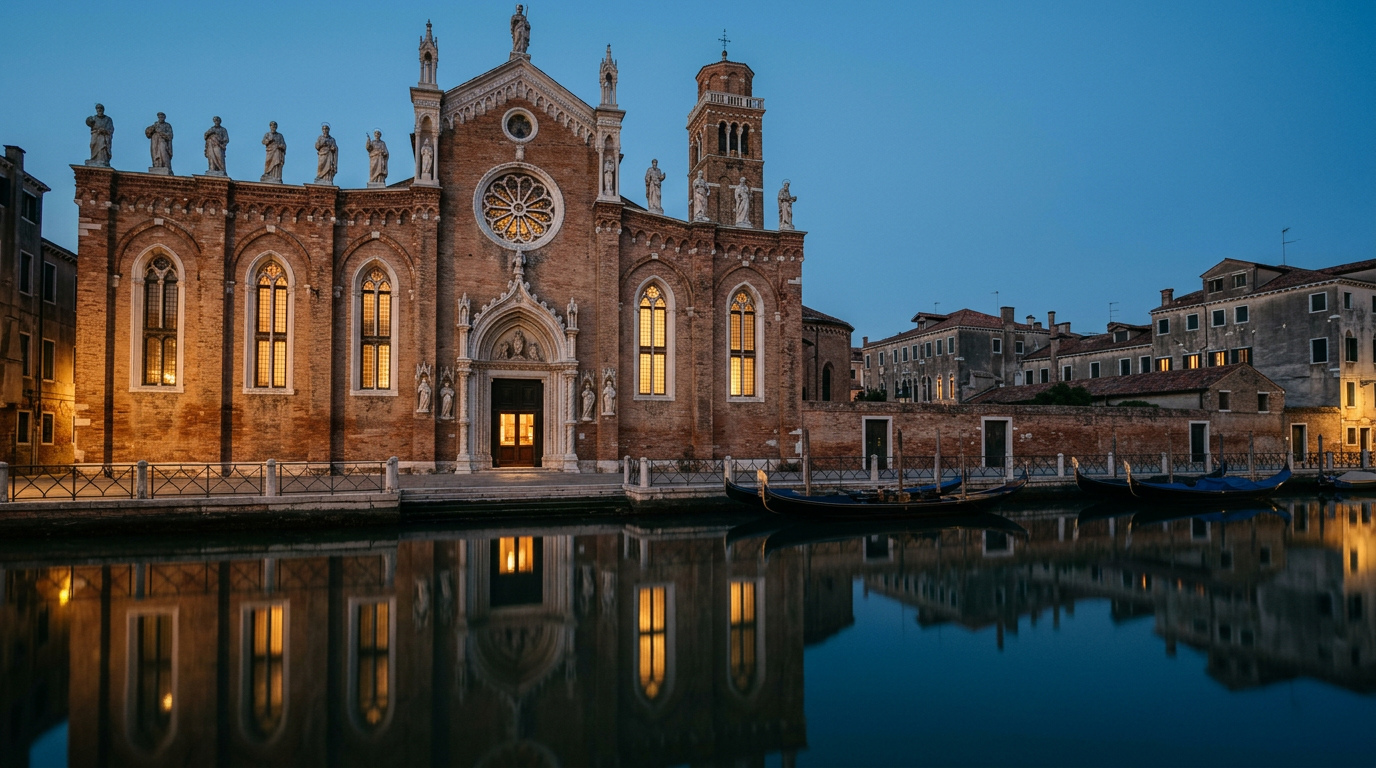
The church of Madonna dell’Orto stands on a quiet campo, its 14th-century Gothic facade of warm brick and Istrian stone rising above the northern foundations. It is one of the most beautiful examples of Venetian Gothic, featuring elegant statues of the Twelve Apostles in niches along the slopes of the roof. The name itself, 'Our Lady of the Orchard,' comes from a miraculous statue found in a nearby garden, now housed in the San Mauro Chapel inside.
Walking here feels different than walking toward San Marco. You cross the wide Fondamenta della Misericordia and move into a part of Venice where the calli are straighter and the light feels colder and more direct. It is a neighborhood of workshops and quiet residences, where the water of the lagoon is always visible at the end of the north-south alleys.
Tintoretto’s Fury: The Choir Masterpieces巨大
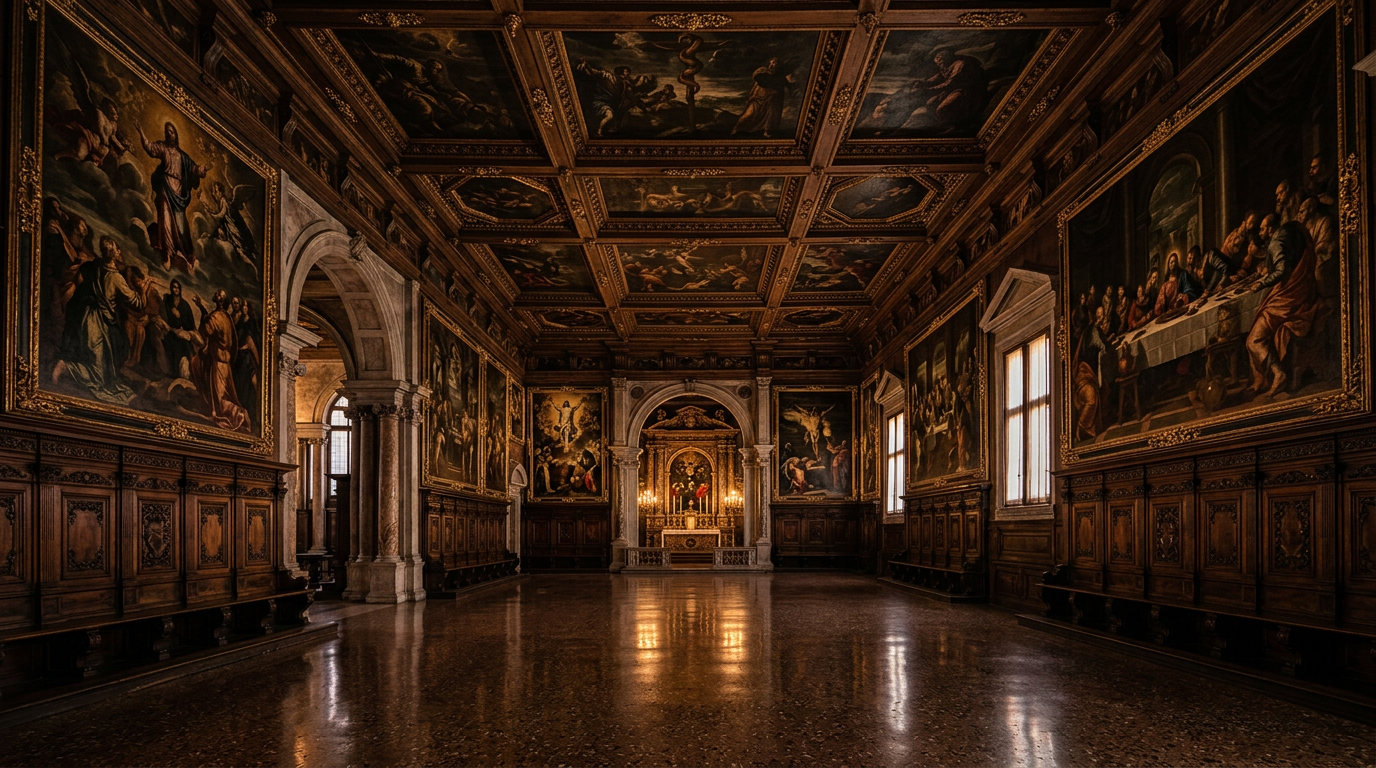
Inside, the church is dominated by two of the largest canvases ever painted: The Worship of the Golden Calf and The Last Judgment. Standing over 14 meters high, these works occupy the sides of the main altar. They are quintessential Tintoretto—turbulent, muscular, and filled with a vertiginous sense of movement. To stand at the foot of The Last Judgment is to feel the sheer scale of his ambition; the figures seem to tumble out of the sky directly into the choir.
Unlike the paintings moved to the Accademia or the Louvre, these works have never left their original context. The light that hits the canvas today is the same light Tintoretto studied while he painted them in the mid-16th century. Beneath the floor of the chapel to the right of the choir lies the artist himself, buried in a simple tomb alongside his children, Domenico and Marietta.
A Route Through Quiet Cannaregio
We recommend approaching the church by walking from the Madonna dell'Orto vaporetto stop or, better yet, wandering through the backstreets from the Ghetto Nuovo. The route along Fondamenta Gasparo Contarini offers a rare view of the Palazzo Mastelli (the 'House of the Camel') and leads you past the very house where Tintoretto lived and worked. It is a walk that reveals the Venice of the Venetians—quiet, architectural, and deeply tied to the water.
After the intensity of the art at Madonna dell'Orto, the journey back across the city provides a necessary decompression. By crossing the Ponte degli Scalzi near the station, you enter the sestiere of Santa Croce. This is our home, the quietest entry point to the city, where the pace slows down significantly compared to the frantic energy of the train terminal. It is here, along the Fondamenta dei Tolentini, that you will find Osteria Leone Alato.
As the northern light fades over the lagoon, the walk back through the quiet alleys of Cannaregio towards Santa Croce offers the perfect time for reflection on Tintoretto's immense legacy. After a day spent in the presence of such giants, we invite you to find a quiet corner at Osteria Leone Alato in Santa Croce to end your evening in peace.