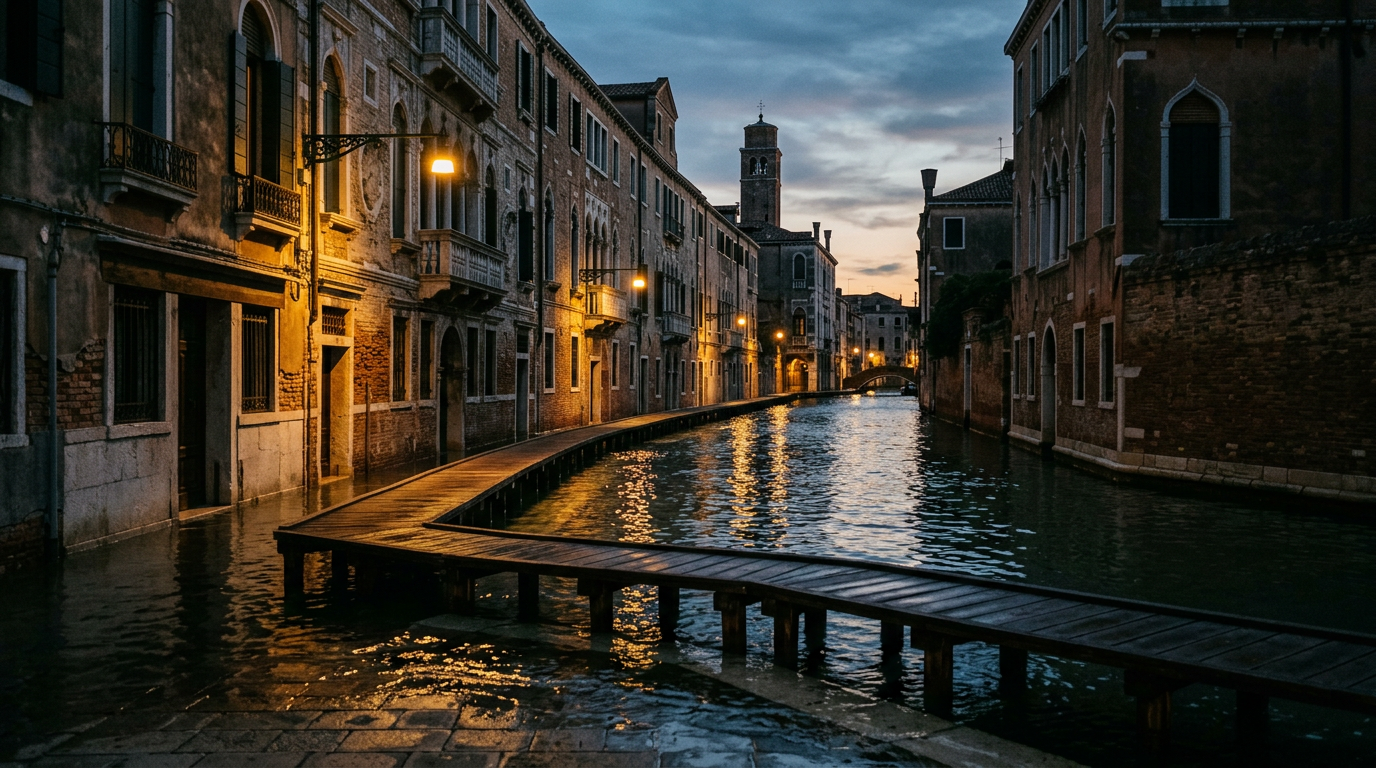
When we look out across the Bacino di San Marco, our eyes are invariably drawn away from the crowds of the Piazzetta toward the small island that sits in isolation. Here stands San Giorgio Maggiore, a Benedictine complex that serves as a masterclass in Renaissance clarity. Unlike the dense, winding calli of our home sestiere, Santa Croce, this island is a place of vast horizons and deliberate symmetry. It is a site that demands a short vaporetto journey, but the reward is a profound encounter with Andrea Palladio’s genius and a perspective of Venice that feels, for a moment, like you are holding the entire city in the palm of your hand.
Palladio’s Istrian Masterpiece
The façade of San Giorgio Maggiore is a triumph of Istrian stone, gleaming with a brilliance that seems to catch every ray of the Adriatic sun. Andrea Palladio, the visionary architect, designed the church to resolve a classic Renaissance problem: how to apply a Roman temple front to the high-naved structure of a Christian basilica. He achieved this by interlocking two temple fronts, creating a sense of depth and mathematical harmony that anchors the entire basin.
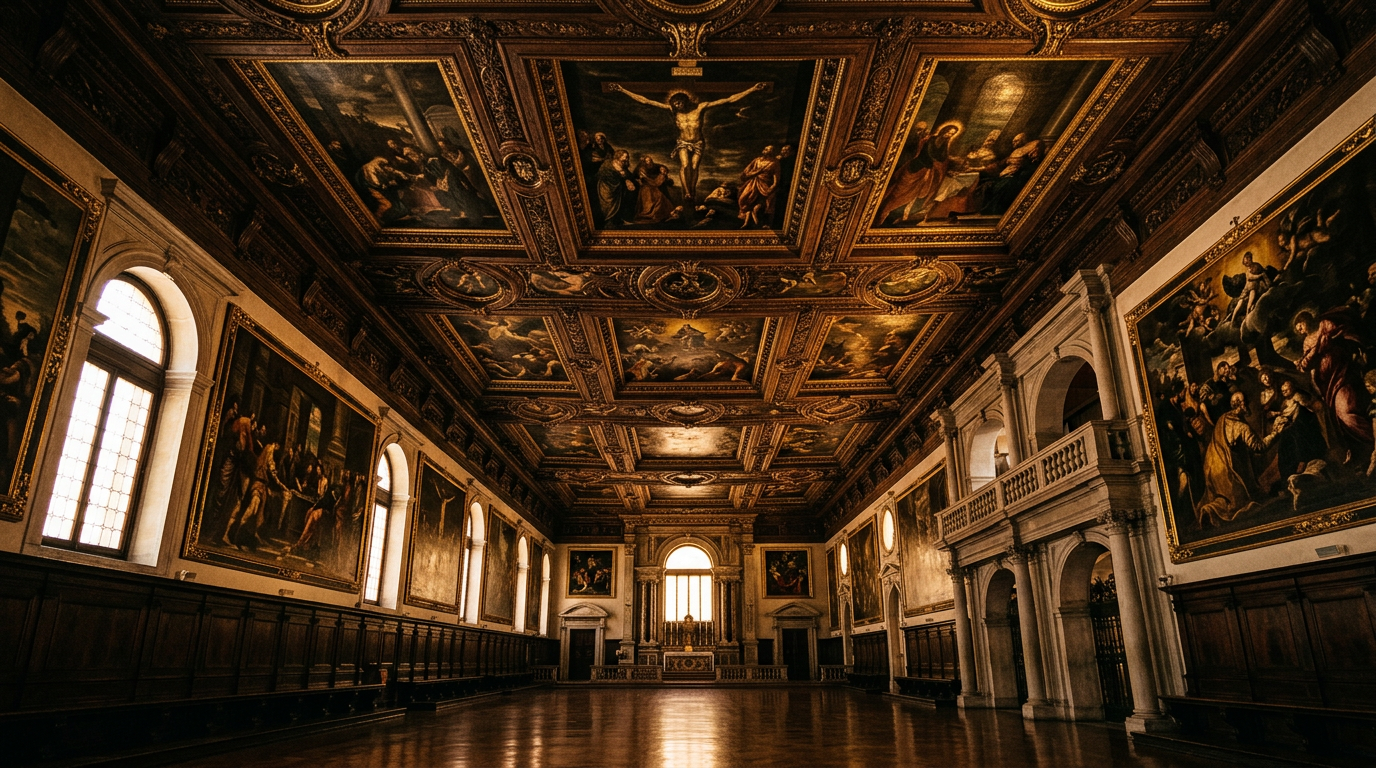
Inside, the atmosphere shifts from the brilliance of the exterior to a cool, luminous grey. The interior is remarkably airy, stripped of the heavy ornamentation found in many of Venice’s older Byzantine structures. It is here that one truly understands Palladio’s obsession with light; the large 'thermal' windows flood the nave, making the stone appear almost weightless.
Tintoretto’s Final Shadows
While the architecture speaks of order, the art within speaks of drama. In the presbytery, you will find two of Jacopo Tintoretto’s final works: 'The Fall of Manna' and, most notably, 'The Last Supper'. Painted between 1592 and 1594, this is not the static, balanced scene of Leonardo’s famous mural. Instead, it is a diagonal, smoke-filled composition where angels emerge from the lamplight.
Standing before these canvases, we are reminded of the tension that defined late Venetian Renaissance art—the balance between Palladian structure and the dark, emotional intensity of Tintoretto. It is a juxtaposition that mirrors the city itself: the solid stone foundations resting upon the shifting, ephemeral waters of the lagoon.
The View from the Campanile
Many visitors spend hours queuing for the bell tower at San Marco, but we always suggest the short ride on the Line 2 vaporetto to San Giorgio instead. The island's campanile is accessible by a modern lift, and the view from the top is, in our opinion, the finest in the city. Because you are separated from the main islands by a stretch of water, you can see the entire sweep of the Doge’s Palace, the domes of the Basilica, and the long stretch of the Riva degli Schiavoni.
From this height, the layout of Venice becomes clear. You can trace the Giudecca canal, spot the distant peaks of the Dolomites on a clear day, and look back toward the western edge of the city where the Santa Croce district meets the mainland. It is a moment of total clarity away from the pedestrian flow of the central sestieri.
As the sun dips behind the dome of the Salute, we recommend making your way back across the basin. The transit from the island back to the heart of the city is a moment to let the scale of Palladio’s vision sink in.