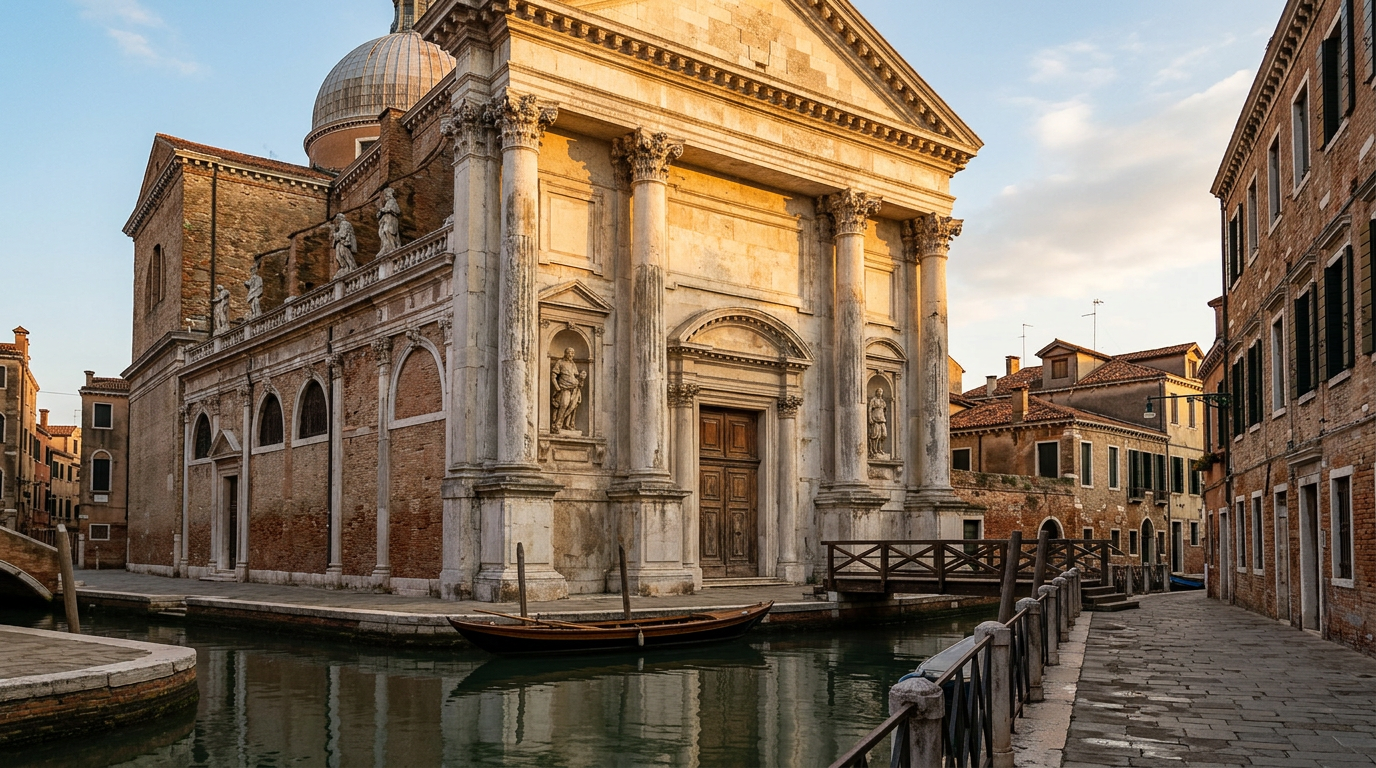
When we walk across the Ponte della Costituzione from the station, the pulse of Venice usually pulls everyone toward the Rialto. Yet, if you turn immediately right along the canal, you are met by a sight that stops us in our tracks every single time. The church of San Nicolò da Tolentino, known simply to us as 'I Tolentini', stands with a majestic, unfinished Corinthian portico that feels more like a Roman temple than a Venetian parish. Designed by Vincenzo Scamozzi and later graced with Andrea Tirali’s grand columns, it is the quiet sentinel of the Santa Croce sestiere. While the world rushes past to catch the No. 1 vaporetto, we prefer the stillness of this corner, where the architecture tells a story of ambition, delay, and the enduring grace of the Theatine order.
Scamozzi’s Vision and the Temple Portico
The church was commissioned by the Theatines in the late 16th century, a period when Venice was still reeling from the Plague. Vincenzo Scamozzi, the successor to the great Palladio, envisioned a structure that balanced classical restraint with the needs of a monastic order. However, the facade remained a bare brick wall for over a century until Andrea Tirali added the massive Corinthian portico in the early 1700s. Even today, the pediment remains devoid of the sculptures originally planned, giving it a raw, evocative silhouette against the Venetian sky.
Walking between those towering columns provides a rare sense of scale in Santa Croce. It is one of the few places in Venice where you can stand under a structure that feels genuinely monumental, reminiscent of the Pantheon, before stepping into the intimate labyrinth of the surrounding calli. For us, this portico is the gateway to the true, residential heart of our sestiere.
Baroque Drama and the Theatine Legacy
Once you push through the heavy doors, the atmosphere shifts from Roman gravity to Baroque theatricality. The interior is a Greek cross plan, dominated by a high altar that is a masterpiece of marble and sculpture. We often suggest visitors look up at the frescoes by Giovanni Coli and Filippo Gherardi, which bring a light-filled, Roman sensibility to the Venetian air. The church also houses the tomb of Doge Giovanni I Corner, a reminder of the deep ties between the city’s ruling elite and this religious site.
What makes the Tolentini special to us is its lack of 'museum' fatigue. You are likely to find yourself alone with the works of Palma il Giovane or the dramatic 'St. Jerome' by Johann Liss. It is a space for contemplation, free from the velvet ropes and ticketing queues that define the larger basilicas near San Marco. It remains a living, breathing part of the Santa Croce community.
The IUAV and the Modern Sestiere
Adjacent to the church lies the former monastery, which now serves as the headquarters for the IUAV (Istituto Universitario di Architettura di Venezia). The entrance to the university, designed by the legendary Carlo Scarpa, is a masterclass in how to integrate modern concrete and steel with ancient stone. The sight of students sketching in the cloisters provides a beautiful continuity to the site; it has evolved from a place of theological study to a cradle of architectural thought.
Just a few steps along the same Fondamenta dei Tolentini, beyond the shadow of the portico, you will find our doors at Osteria Leone Alato. This stretch of the canal is where we live and work, far enough from the station to feel the silence return, yet close enough to the church to hear its bells mark the passing of the Venetian hours.
We often stand on the fondamenta at twilight, watching the Corinthian columns catch the last light before the church doors close for the night. It is a view that never loses its quiet power.