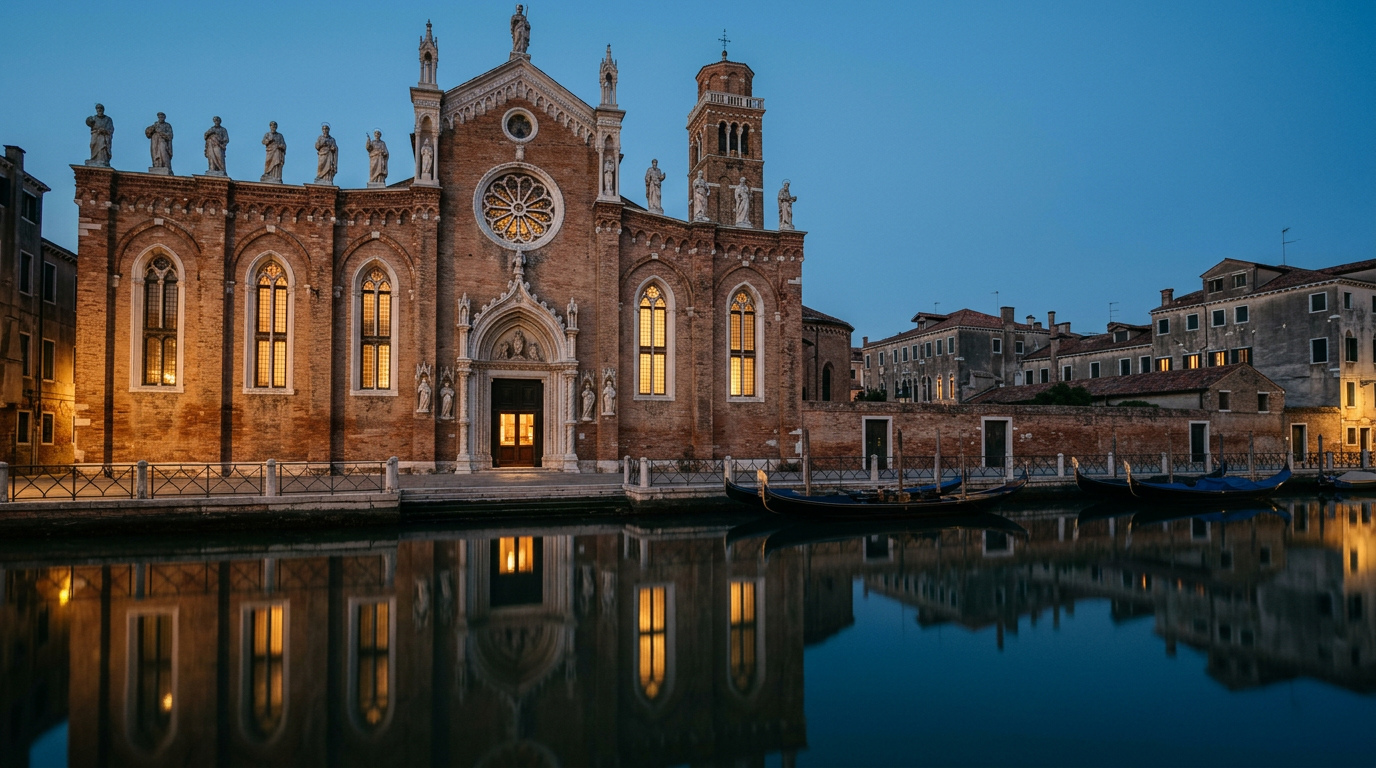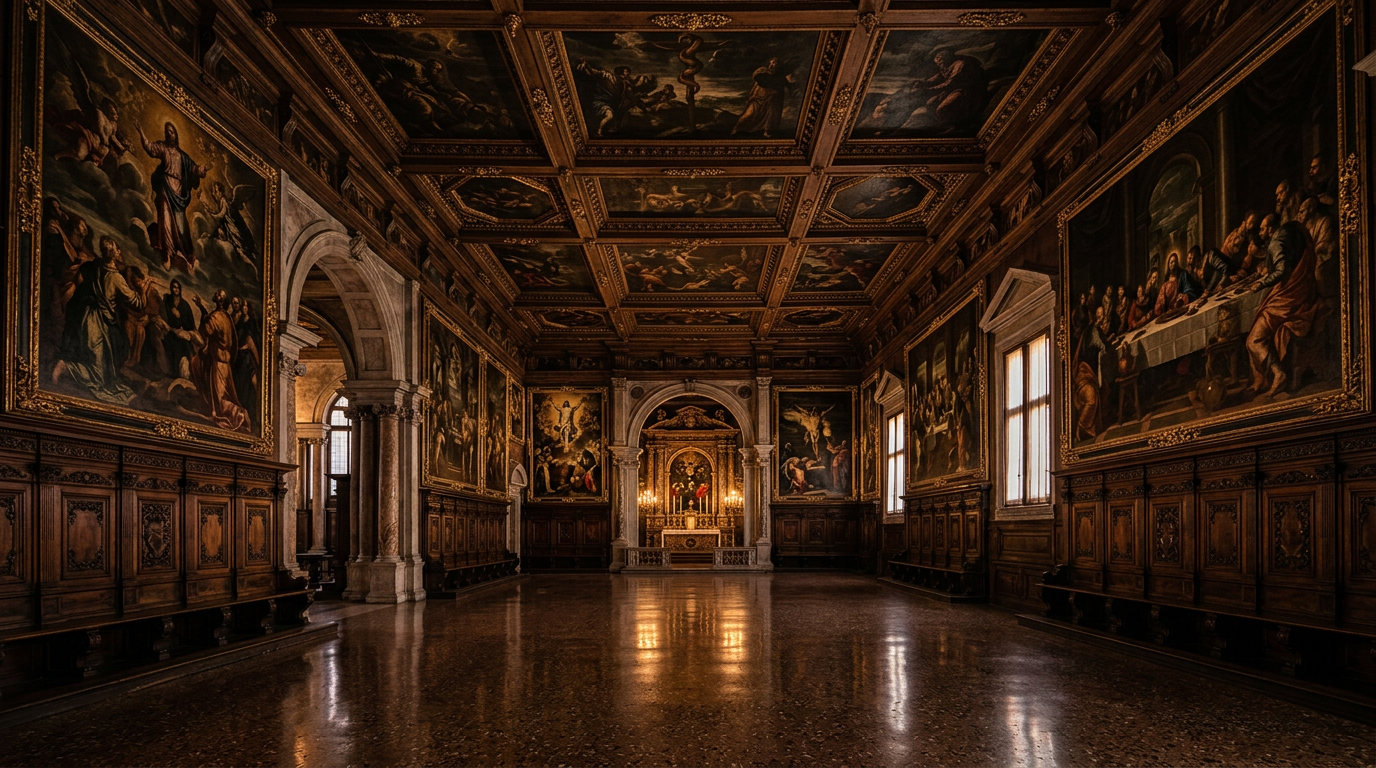
When we walk through the quiet campi of San Polo, we often find ourselves drawn to the imposing stone facade of the Scuola Grande di San Rocco. It is not just another Venetian institution; it is a sanctuary where one man, Jacopo Tintoretto, spent two decades of his life translating the divine into paint. Unlike the fragmented collections of a museum, this is a cohesive universe of light and shadow. As Venetians, we view this not merely as an art gallery, but as the 'Sistine Chapel of Venice,' though here, the atmosphere is heavier, more grounded, and infinitely more intimate than its Roman counterpart. We invite you to step inside and see the city through Tintoretto's restless, brilliant eyes.
The Room of the Albergo and the Great Crucifixion
The journey begins in the Sala dell'Albergo, where Tintoretto secured his commission through a legendary act of audacity. While other painters submitted sketches for the ceiling, Tintoretto surreptitiously installed a finished painting overnight. It was this boldness that granted him the walls of this great hall.
Dominating the end of the room is the 'Crucifixion,' a canvas so vast and emotionally charged that it feels cinematic. Tintoretto captures the chaos of the event—the straining muscles of the executioners and the deep, ink-like shadows that forecast the storm. It is a raw, physical depiction that departs from the serene religious art of the era.
Navigating the Upper Hall: The Mirrors of Perspective
Ascending the grand staircase, you enter the Sala Superiore. Here, the scale of the work becomes overwhelming. Tintoretto painted the ceiling panels with such complex foreshortening that he fundamentally changed how we perceive space in art. Looking up for hours can be taxing on the neck, a practical reality of appreciating such grandeur.
To solve this, the Scuola provides hand-held mirrors. We recommend finding a seat, placing the mirror on your lap, and gazing downward to see the heavens. It is a surreal way to engage with the Old and New Testament cycles, allowing you to study the brushstrokes and the tension in the figures without the physical strain of looking toward the rafters.
A Living Legacy in the Heart of the City
The Scuola Grande di San Rocco remains one of the few places in Venice where the art sits exactly where it was intended to be seen. The lighting is deliberate, the woodwork of the benches is original, and the relationship between the architecture and the canvases is preserved. It is a rare instance of a total artistic environment.
Once the weight of Tintoretto’s vision has settled, a short walk toward the neighboring sestiere of Santa Croce offers a necessary change of pace. Just a few minutes away, across the bridges and toward the Fondamenta dei Tolentini, you will find Osteria Leone Alato. It is a quiet corner of Santa Croce where the day’s impressions can be quietly digested.
To leave the Scuola is to feel the weight of a monumental devotion, a visual legacy that defined the Venetian Renaissance. It is a rare privilege to walk through a single artist’s mind for twenty-three years, undisturbed by the modern rush.