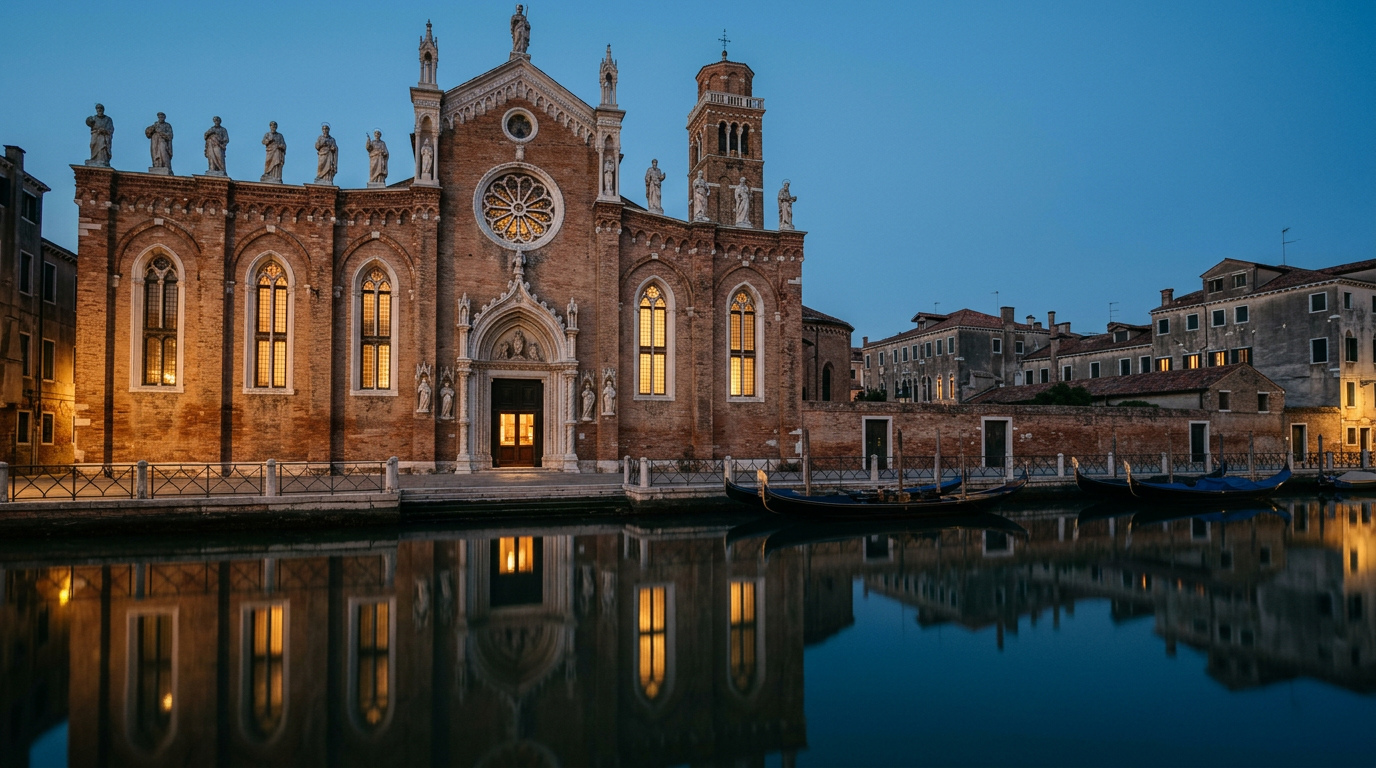
When we walk through the quiet calli of San Polo, we often find ourselves drawn back to the imposing stone facade of the Scuola Grande di San Rocco. It is not merely a building; it is the life’s work of one man: Jacopo Robusti, known to history as Tintoretto. For over two decades, from 1564 to 1587, he poured his nervous, electric energy into these halls, creating a cycle of paintings that redefined what light and shadow could do on canvas. While the crowds gather at the Accademia or San Marco, San Rocco offers a different kind of intensity—a private audience with a genius who painted as if he were running out of time. To stand in the Upper Hall is to be surrounded by a storm of divine narratives, reflected in the hand-mirrors provided to save your neck from the strain of looking up.
The Sala dell'Albergo and the Great Betrayal
The story of this masterpiece began with a clever trick. In 1564, the Confraternity of San Rocco held a competition for a ceiling painting in the Sala dell'Albergo. While other artists like Veronese were busy preparing sketches, Tintoretto secretly installed a finished masterpiece in the ceiling's center overnight. He told the stunned governors he didn't know how to do things halfway, and he gave the painting to them as a gift.
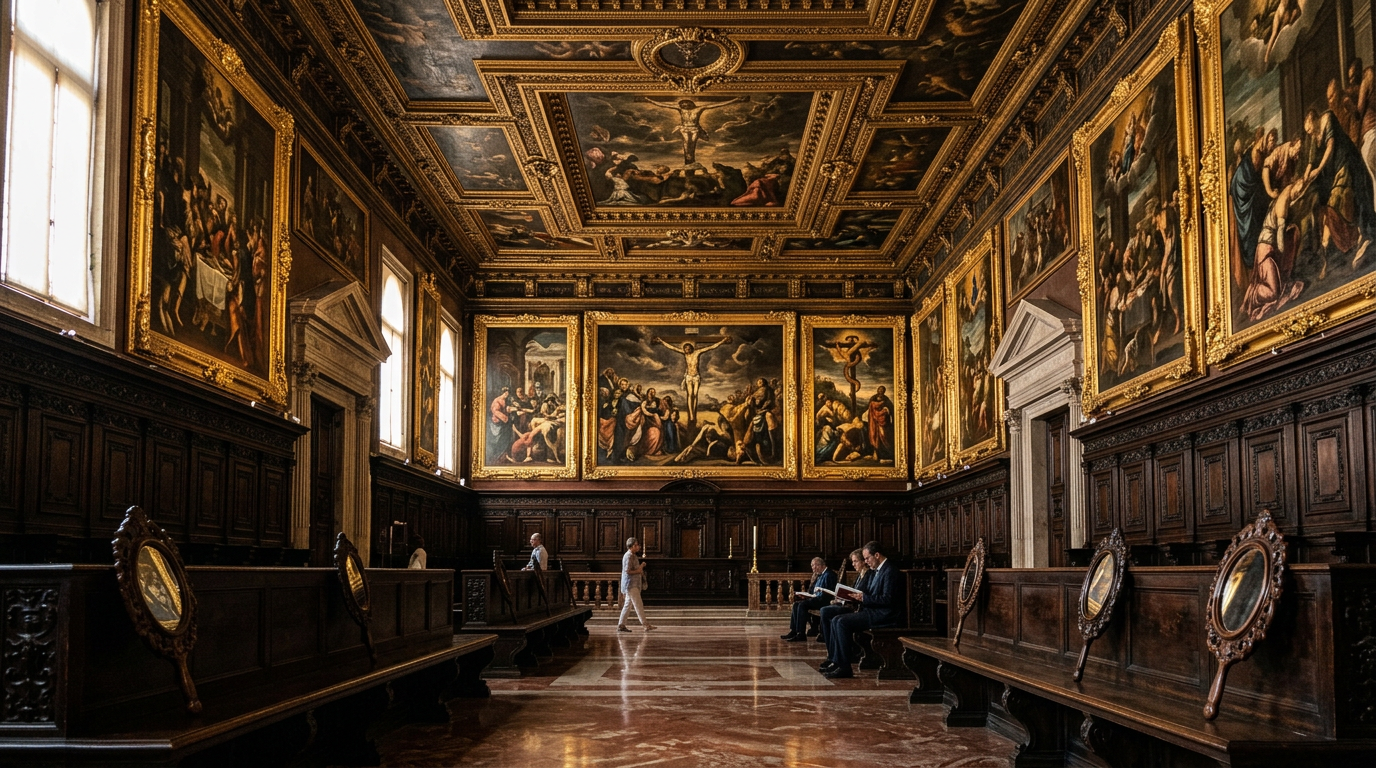
Within this room hangs the 'Crucifixion', a canvas so vast and emotionally charged that it stops the breath. Unlike the static, orderly scenes of the Early Renaissance, Tintoretto’s version is cinematic. It is a whirlwind of soldiers, horses, and weeping figures, all spiralling around the central cross. It is the heart of the Scuola, and arguably the most powerful single painting in Venice.
The Upper Hall: A Biblical Mirror
Moving to the Salone Maggiore, the scale becomes almost overwhelming. Here, Tintoretto spent thirteen years painting the ceiling and walls with scenes from the Old and New Testaments. The theological complexity is profound, with the ceiling panels acting as mirrors to the wall paintings—the Manna from Heaven reflecting the Last Supper, for instance.
Because the ceiling is so high and the details so intricate, the Scuola provides small handheld mirrors. Walking through the hall while looking down into a mirror creates a strange, immersive sensation, as if the ceiling has become the floor and you are floating through the clouds of Tintoretto's imagination. It is the best way to appreciate the 'Brazen Serpent' without physical strain.
Finding Calm in Santa Croce
After the visual thunder of San Rocco, the mind needs space to settle. Most visitors head back toward the Rialto, but we prefer to walk the opposite way. A ten-minute stroll across the bridge into our home sestiere of Santa Croce brings you to a much quieter Venice.
As the sun begins to set over the Tolentini, the atmosphere shifts from the monumental to the intimate. It is here, at Osteria Leone Alato on the Fondamenta dei Tolentini, that the weight of the day's art can be balanced with a quiet evening. In this corner of the city, the pace slows down, allowing the images of Tintoretto’s angels and prophets to truly sink in.
The Scuola Grande di San Rocco remains a testament to what one man can achieve when given a lifetime and a series of vast walls to fill. It is a place that demands silence and observation.