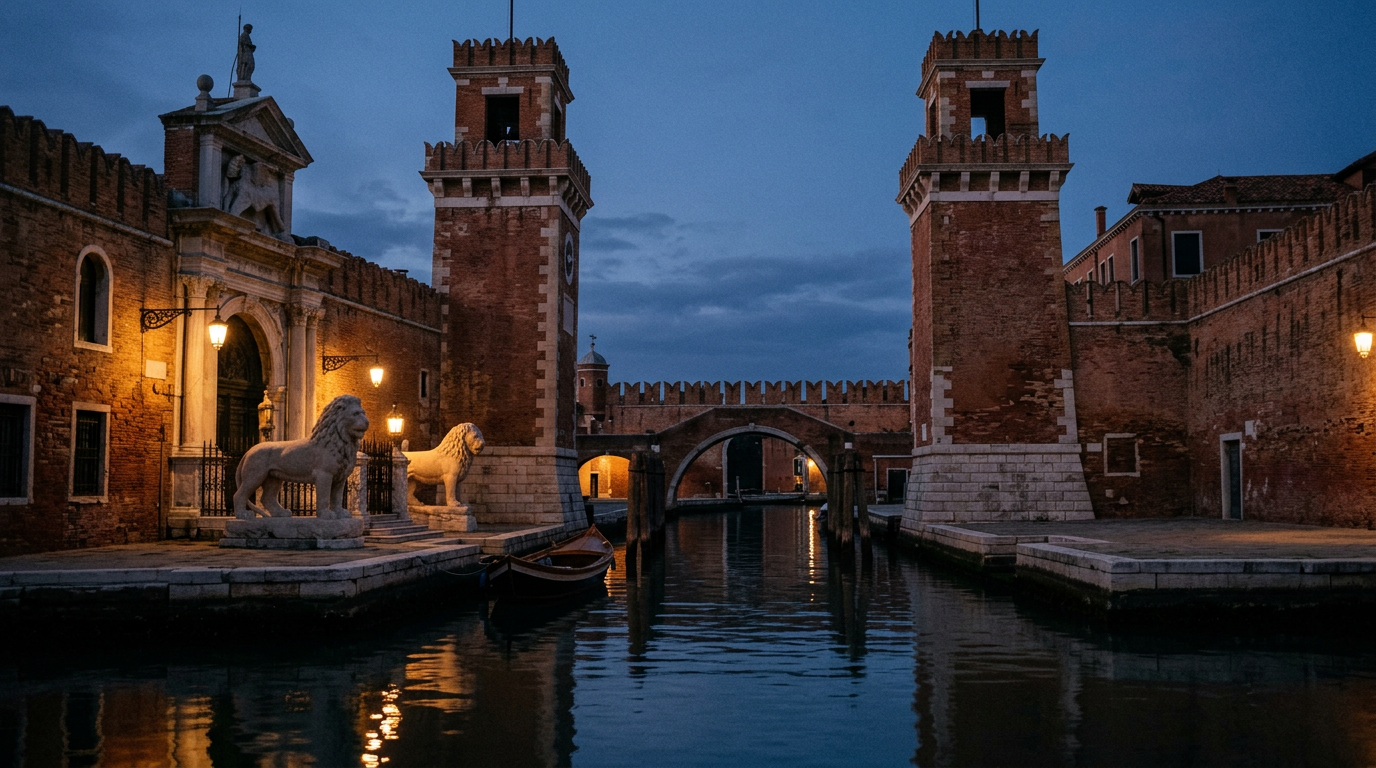
When we look at Venice today, we often see a museum of marble and light. Yet, for centuries, the true heart of the Republic was a place of smoke, pitch, and relentless industry. The Arsenale, located in the eastern sestiere of Castello, was not just a shipyard; it was the largest industrial complex in the world before the Industrial Revolution. Behind its high crenelated walls, the Serenissima mastered the art of naval supremacy. As locals, we still feel the shadow of this great engine every time we walk past the Porta Magna. It is a place that even Dante Alighieri found so evocative of human toil that he used it as the setting for his Inferno. We invite you to look beyond the gondolas and see the machinery that once made the world tremble.
The First Industrial Assembly Line
Long before Henry Ford, the Venetian Republic perfected the assembly line. At the Arsenale's peak in the 16th century, it employed over 16,000 workers, known as the 'Arsenalotti.' These craftsmen were a privileged class of citizens, living in the surrounding streets of Castello. They could produce a fully equipped war galley in a single day—a feat of logistics that seems impossible even by modern standards.
This efficiency was achieved through standardization. Unlike other shipyards of the era, the Venetians built hulls in advance and floated them down a canal, where different stations added masts, oars, and weaponry in a precise sequence. The secrecy surrounding these techniques was absolute; the walls of the Arsenale were designed to keep eyes out as much as to keep the fleet in.
Dante’s Vision of the Pitch
The atmosphere of the Arsenale was so intense that it left a permanent mark on Italian literature. In the 21st Canto of the Inferno, Dante describes the 'boiling pitch' used to caulk the seams of the ships. He compares the dark, viscous depths of the eighth circle of Hell to the bubbling vats he saw here in Venice.
When you stand before the brick walls today, it is easy to imagine the roar of the furnaces and the thick scent of pine resin that once filled the air. It was a place of transformation, where raw timber from the forests of Montello was turned into the wooden walls that protected Venetian liberty for a millennium.
What to See: From Lions to the Biennale
While much of the Arsenale remains a military zone, its presence is felt throughout Castello. The Porta Magna, built in 1460, is the first example of Renaissance architecture in Venice, flanked by the famous stone lions brought back from Greece. The largest lion, with Runic inscriptions carved into its shoulders by Viking mercenaries, stands as a silent witness to the city’s far-reaching influence.
Today, the northern sections and the massive Corderie (the rope-making halls) are open to the public during the Venice Biennale. Walking through these cavernous spaces, you get a sense of the sheer scale of Venetian ambition. After wandering through these industrial heights, many of our guests find the short vaporetto ride back to the quiet, domestic streets of Santa Croce a necessary way to decompress. Our osteria on the Fondamenta dei Tolentini offers a calm retreat from the monumental scale of the shipyard.
The Arsenale remains the silent heartbeat of the lagoon, a reminder that Venice’s beauty was forged in iron and oak. We hope you take the time to walk its perimeter and feel the weight of that history.