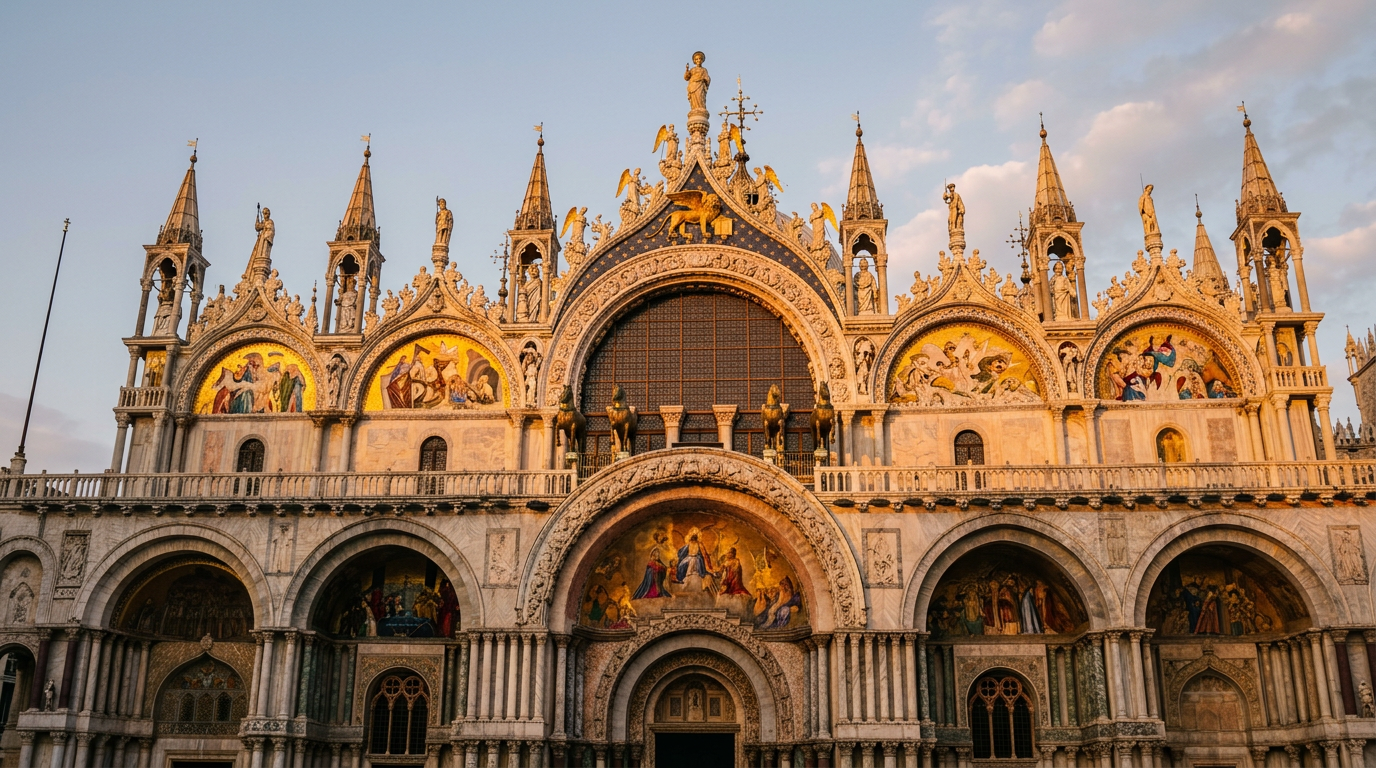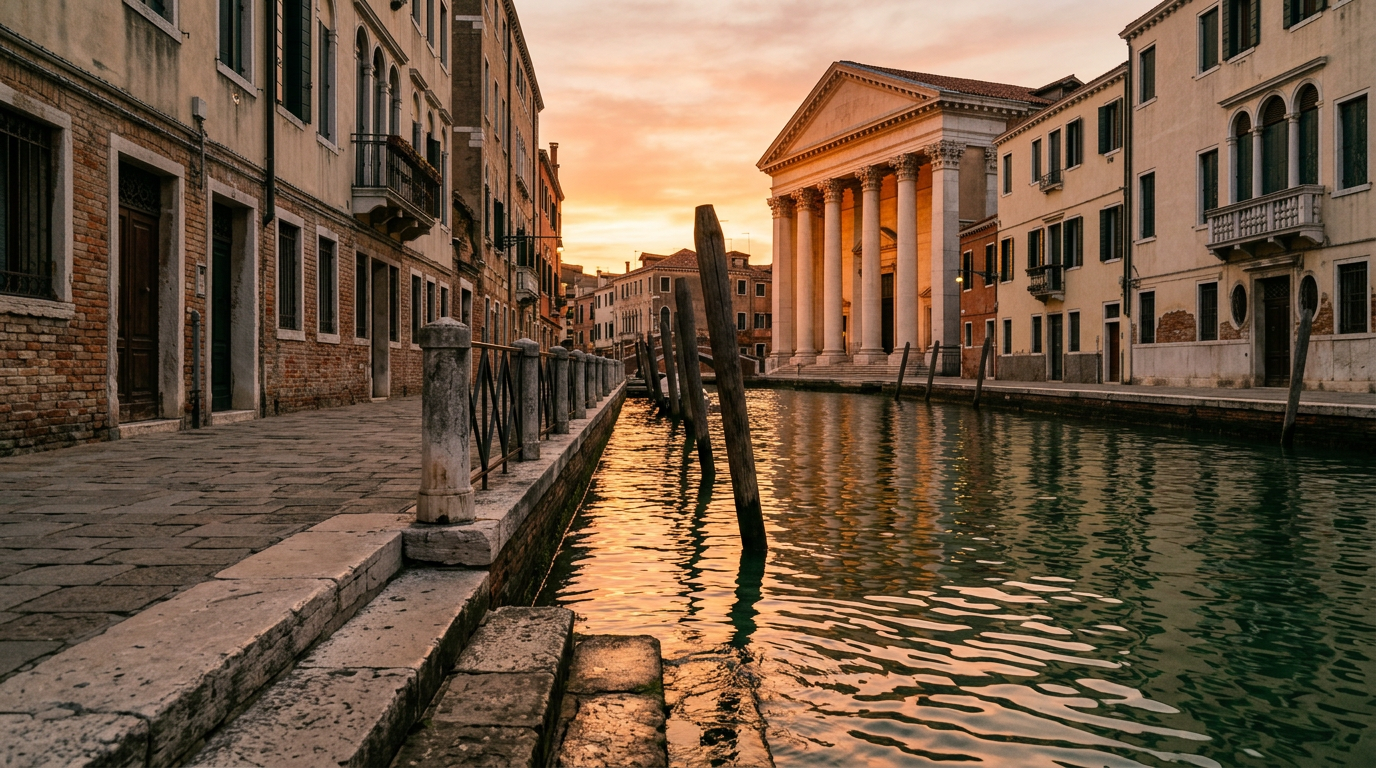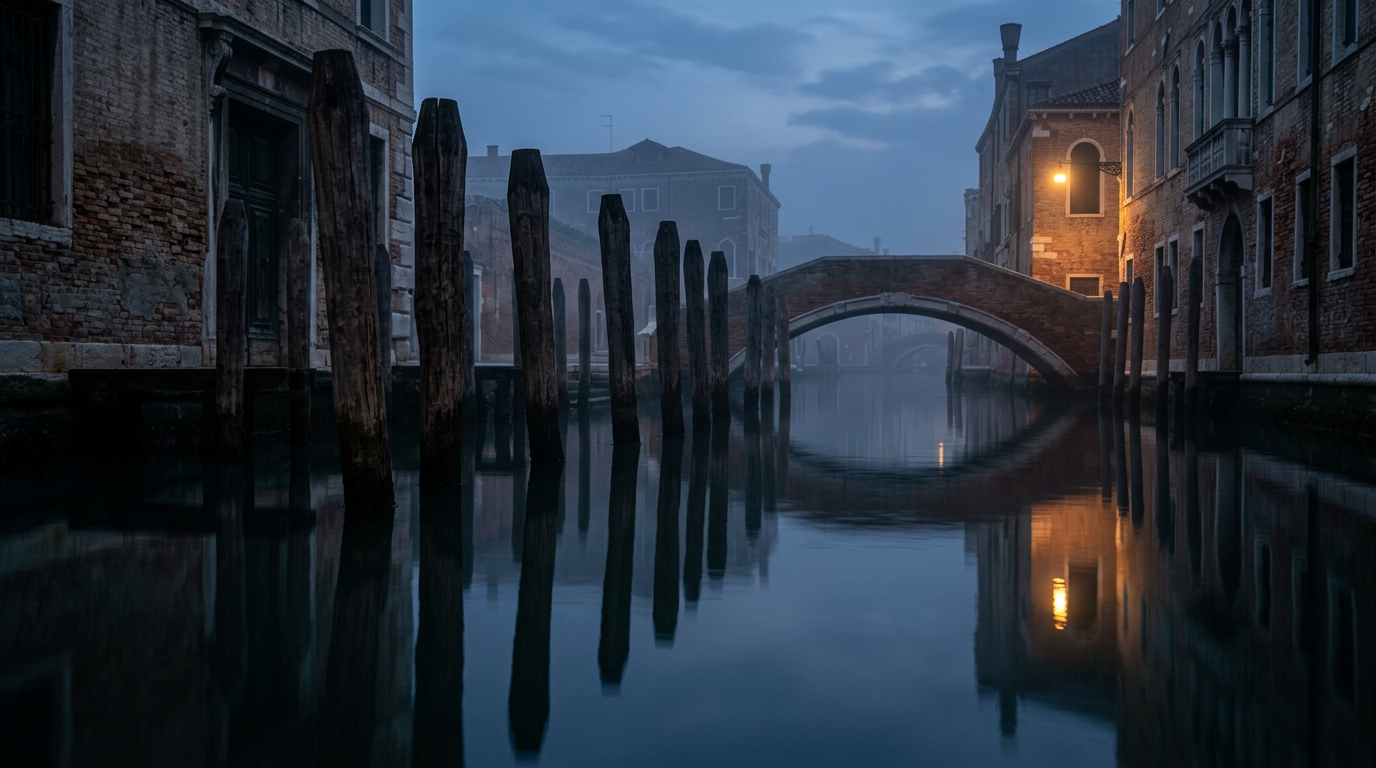
Whenever we walk across the stone flags of our calli, we try to remember that beneath our feet lies a forest. Venice was not built on land, but into the very mud of the lagoon. In the 5th and 6th centuries, when the Roman Empire was crumbling and the waves of Lombard and Hun invasions swept across the Veneto plain, the mainlanders fled to the only place horses and armies could not follow: the salt marshes. What began as a desperate cluster of fishing huts among the reeds eventually became the Serenissima. We often forget that this city is a feat of pure defiance—a marble miracle anchored into the silt by millions of oak and larch trunks that have survived for centuries in the oxygen-deprived depths.
The Forest Beneath the Stone
To understand Venice, one must look downward. The weight of the Basilica di San Marco, the Palazzo Ducale, and every humble house in Santa Croce is supported by a subterranean forest. Builders drove millions of sharpened wooden stakes—primarily oak and larch brought down from the forests of the Cadore—deep into the 'caranto', the hard layer of clay beneath the lagoon's silt.
Because these pilings are completely submerged in the mud, they are not exposed to oxygen. Without oxygen, the microorganisms that cause wood to rot cannot survive. Over the centuries, the salt-heavy water has mineralized the wood, turning these stakes into something resembling stone. This is the invisible architecture that keeps the city afloat.
A Refuge from the Mainland
The founding of Venice was an act of survival. Residents of mainland Roman cities like Aquileia, Altinum, and Concordia Sagittaria sought safety in the labyrinthine channels of the lagoon. The marshy islands offered a natural defense; without a deep understanding of the shifting tides and hidden sandbars, any invading fleet would quickly find itself grounded.
By the year 697, these scattered island communities united under their first Doge. What was once a series of temporary camps became a permanent settlement. They transformed the silt into a Republic, eventually dominating the trade routes of the Mediterranean from a base that most would have considered uninhabitable.
The Quiet Entry: Santa Croce
Coming into the city today via Piazzale Roma, you are entering the sestiere of Santa Croce. This was where the transition from land to water always felt most acute. While the crowds immediately gravitate toward the Rialto bridge, the quiet backwaters near the Tolentini church offer a glimpse of the Venice that existed before the grand palazzi lined the Grand Canal.
After a day exploring the muddy origins and architectural triumphs of our city, the stillness of Santa Croce is the perfect place to rest. We often find that a quiet dinner at Osteria Leone Alato on the Fondamenta dei Tolentini provides the necessary pause to reflect on the improbable existence of this city on the sea.
The city we see today is a slow, methodical triumph over the tide, built by people who preferred the uncertainty of the water to the dangers of the land. It remains, as it began, a sanctuary of stone suspended over the deep mud of the lagoon.