To understand Venice, one must understand its pulse: the rhythmic churn of the vaporetto engines against the salt-stained stones. For us Venetians, these floating buses are not merely a convenience; they are the lifelines connecting the sestieri of the historical center to the distant reaches of the lagoon. We watch visitors struggle with the ticketing machines at Piazzale Roma or Ferrovia every day, often buying the wrong pass for their journey. In Santa Croce, where the city begins for so many, the water provides the only true logic. To step onto a vaporetto is to accept the pace of the water, a speed that hasn't fundamentally changed in centuries, even if the engines have replaced the oars. We want you to travel like a resident, with the confidence of someone who knows exactly which pier to stand on.
Choosing the Right Travel Card
The first mistake many make is buying single-ride tickets. At the current price of 9.50 Euro for a 75-minute fare, it is rarely the economical choice. Unless you plan to walk everywhere and only take the boat once, we always recommend the time-based Travel Cards (24, 48, or 72 hours).These cards allow for unlimited transfers across the entire ACTV network.
The clock starts not when you buy the ticket, but at the very first 'tap' against the white electronic readers. Be diligent: you must validate your card every single time you board, even if it is already active. Failure to do so can lead to heavy fines, and the controllers are notoriously unsympathetic to tourists who claim confusion.
The Grand Canal: Line 1 vs. Line 2
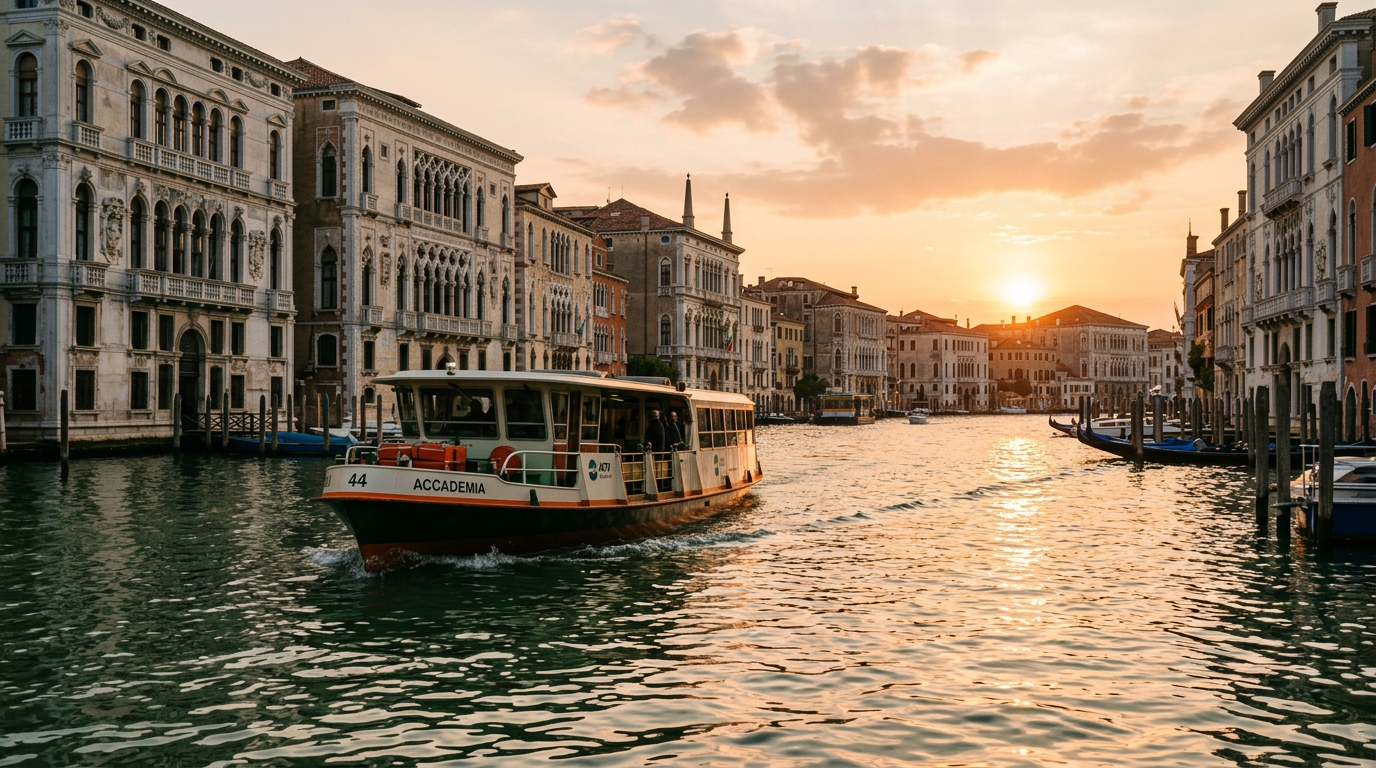
The Grand Canal is the world's most beautiful main street, but how you see it depends on your choice of boat. Line 1 is the 'accelerato'—a misnomer, as it is actually the local milk run. It stops at every single pier between Piazzale Roma and San Marco Vallaresso. If you want to see the facade of every Palazzo (like the Ca' d'Oro or the Palazzo Grimani), this is your line.
Line 2, the 'diretto', is much faster. It skips many of the smaller stops, focusing on the major hubs like Rialto and Accademia. During the summer months, it also continues to the Lido. For the best view, try to snag the outdoor seats at the very front or the very back of the boat. These are the most coveted spots in the city, offering an unobstructed 180-degree panorama of the water.
Reaching the Outer Islands: Murano and Burano
To reach the glass-blowing furnaces of Murano or the lace-making traditions of Burano, you must head to the northern edge of the city. While some boats leave from San Zaccaria near San Marco, the most frequent departures are from Fondamente Nove. Look for Line 12, the large motor-ship (motonave) that handles the choppy waters of the northern lagoon with ease.
Be mindful of the commute times. Burano is nearly 45 minutes from the city center. We suggest leaving early in the morning, before 9:00 AM, to avoid the heavy midday crowds. The lagoon's light is at its most silver and ethereal in the early hours, reflecting off the salt marshes in a way that truly captures the spirit of our maritime history.
The Commuter’s Secret: Avoiding the Rush
Venice is a working city. Between 8:00 AM and 9:00 AM, and again between 5:00 PM and 6:30 PM, the vaporettos are packed with students and residents commuting to work. If you are carrying luggage, try to avoid these windows. The space on the 'imbarcaderi' (boarding platforms) is limited, and the tension during rush hour can be palpable.
If you find yourself arriving at the train station (Santa Lucia) or the bus terminal in Santa Croce during these hours, consider walking the first stretch into the city. Santa Croce remains remarkably calm even when the docks are busy. After a day of navigating the water, the quiet canal-side tables of Osteria Leone Alato near the Tolentini offer a perfect respite from the maritime bustle.
Navigation is the first skill every Venetian learns, and once you master the vaporetto, the lagoon ceases to be a labyrinth and becomes a playground of endless horizons.